September 7, 2026
Why Startups Are Dropping Agency Retainers for AI Marketing Agents That Run on a Weekly Schedule
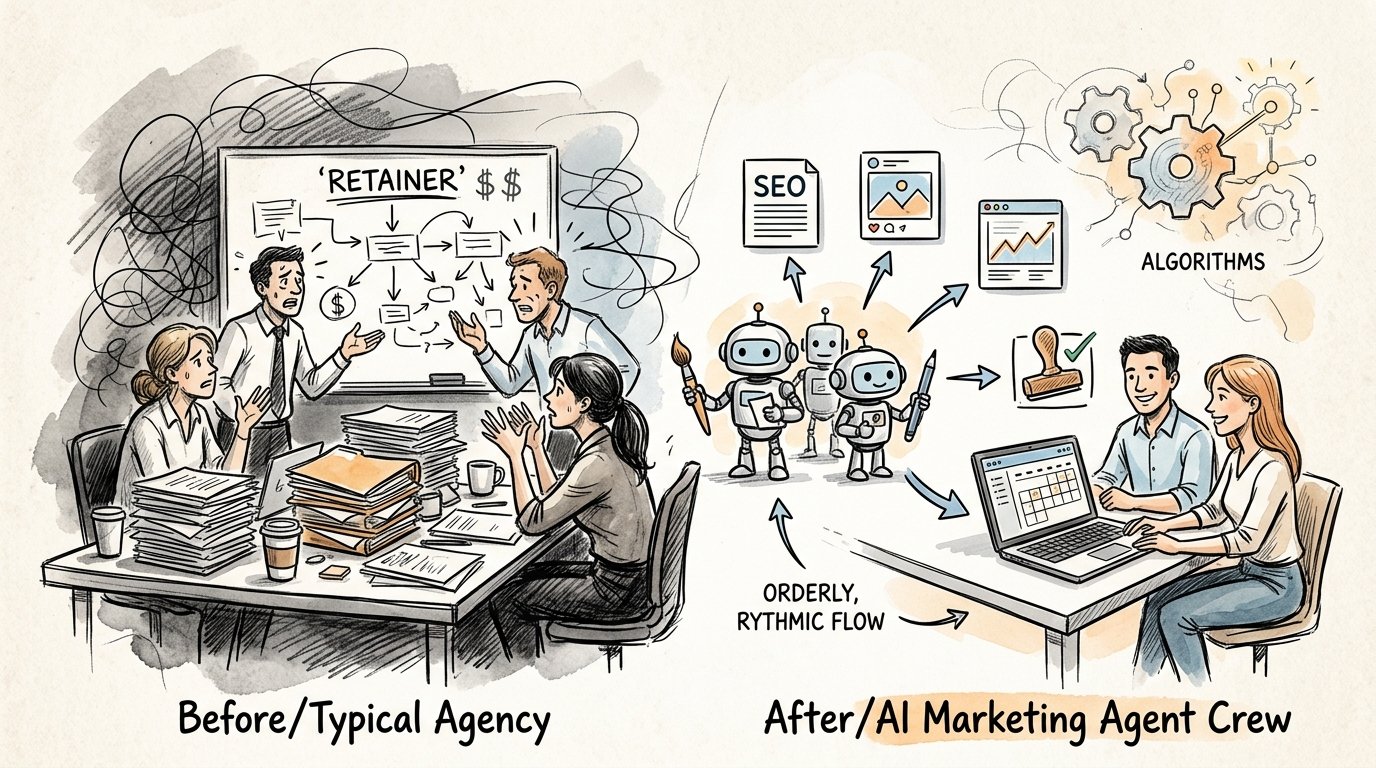
An AI marketing agent crew delivers SEO articles to your CMS, social posts to your calendar, and a cross-channel report to your dashboard every week — on a fixed schedule, at a fraction of the cost of a typical agency retainer, and with nothing going live until you approve it.
That contrast matters for startups because the traditional agency model bundles strategy, execution, and account management into a monthly fee that rarely maps to predictable output on a predictable timeline.
What a Marketing Agency Retainer Actually Costs — and What It Doesn’t Guarantee
Retainer fees for full-service marketing agencies typically run $3,000–$8,000 per month for small businesses, with specialist digital agencies often starting at the higher end of that range. That’s $36,000–$96,000 per year — before any paid media spend.
What that budget does not guarantee:
- A defined output cadence. Most retainer scopes describe services, not weekly deliverables.
- Visibility into execution. Founders typically see a monthly report, not a running log of what was researched, drafted, reviewed, or published each week.
- Fast feedback loops. Requesting a revision often means waiting for the next sprint cycle or a scheduled check-in.
- Exclusive attention. Your account is one of many a team manages simultaneously.
According to HubSpot’s State of Marketing Report, website/blog/SEO remains the #1 ROI-generating channel for B2B brands, and blog posts rank among the top five highest-ROI content formats. Yet for many startups on agency retainers, consistent weekly article output is exactly what slips — delayed by competing priorities, approval queues that sit on the agency side, or scope language that caps deliverable count without defining delivery timing.
The result is a model where the founder pays for marketing capacity but cannot observe or steer it in real time.
How a Weekly AI Agent Schedule Changes the Equation
An AI marketing crew built around specialized agents replaces opaque execution with a defined, observable cadence. Each agent has a specific job and runs on a schedule the team controls.
The weekly content pipeline
A Scout agent researches topic opportunities each week using live Search Console data and brand positioning — surfacing keyword gaps and attaching source URLs before any writing begins. A Writer agent drafts a long-form article with verified inline citations. An Editor agent scores the draft against a brand rubric. The approved article lands in WordPress or Webflow as a draft, ready for a single click to publish.
On a platform like mktcrew, first article drafts are waiting in your CMS by Day 3 of onboarding. A Repurposer agent then turns each published article into channel-specific social posts for LinkedIn, Facebook, Instagram, and X — all queued for review before anything posts.
Transparent run history vs. a monthly report
The sharpest operational difference between an agency retainer and an AI agent crew is when information travels. With a retainer, the standard feedback mechanism is a monthly report summarizing what happened. With an AI crew, every agent run is logged: when it executed, what it produced, and whether it succeeded. A founder can check the pipeline at any point in the week — not just at billing time.
This is the gap that comparison content in the market almost entirely ignores. Cost comparisons are easy to find. Side-by-side visibility into execution cadence is not.
Human approval at every step — not agency-side gatekeeping
Nothing in an AI agent workflow publishes, posts, or changes without explicit human approval. This is a structural design choice, not a setting. Articles land as CMS drafts. Social posts wait on a calendar. Ad optimization agents surface evidence-backed recommendations only — they never touch live campaigns. The human approval layer is always the last step before anything reaches a live channel.
This inverts the agency model, where approval often sits on the agency side (waiting for a senior review or content director sign-off) and the founder sees the output only after those internal gates have been passed.
The Hybrid Model: Keeping Strategy While Replacing Execution
One option that rarely appears in agency comparison discussions is the hybrid model: retaining a fractional CMO or strategist for positioning, roadmap, and channel decisions — while replacing agency execution with an AI crew.
A fractional CMO typically provides 8–20 hours per month of strategic input. That function — defining what to do and why — is genuinely difficult to replace. The execution layer underneath it — researching topics, writing drafts, reviewing brand alignment, scheduling posts, pulling weekly reports — is the repeatable operational work that 20 specialized AI agents are designed to handle on a defined weekly cadence.
This hybrid approach gives lean teams strategic direction without paying for execution hours that could be automated, and it avoids the all-or-nothing choice of either a full agency retainer or a fully DIY approach.
What an AI crew covers on one subscription
A single subscription to an AI marketing crew can cover:
- Weekly SEO article research, drafting, editorial review, and CMS delivery
- Social post repurposing across LinkedIn, Facebook, Instagram, and X
- Daily news monitoring and on-brand social draft creation
- Google, Meta, and LinkedIn Ads recommendations (surfaced for review, never applied automatically)
- Weekly competitor monitoring and Google Business Profile audits
- Monthly AI search visibility checks (whether ChatGPT or Perplexity mention your brand)
- Weekly cross-channel reports compiled from GA4, Search Console, social, and ad accounts
HubSpot data shows small businesses are 23% more likely than average to see ROI from blog posts — yet consistent weekly publishing is exactly the output a lean team loses first when bandwidth is scarce. An agent crew removes that bottleneck without adding headcount.
Making the Switch: What to Evaluate
Before dropping an agency retainer, map what the retainer actually delivers week by week — not what the scope promises. Common findings:
- One or two articles per month, not per week
- Social posting that goes through a multi-day approval cycle on the agency side
- Reporting that arrives 10–15 days after the month closes
- No visibility into whether draft content was revised internally or simply delayed
Then compare that against what a weekly AI agent schedule would deliver in the same period, with a run history you can check at any point. Most startups find the output volume, delivery speed, and approval transparency shift substantially in favor of the agent model.
A 15-day free trial with no credit card required is a practical way to run the comparison in real time — first drafts in your CMS by Day 3, first analytics report by Day 7 — without committing to a new retainer before you’ve seen the work.
The Control Argument Is Stronger Than the Cost Argument
The cost comparison between an agency retainer and an AI crew subscription is real and usually favors the crew. But the more durable argument is control: knowing what ran, when, what it produced, and having the final approval decision on every piece of content, post, and recommendation before it touches your brand.
For founders who’ve experienced the friction of chasing monthly reports, waiting on agency revision queues, or trying to redirect strategy mid-retainer, that control difference is what makes the switch stick.