September 6, 2026
How AI Agents Keep Your Google Business Profile Optimized Without Weekly Manual Audits
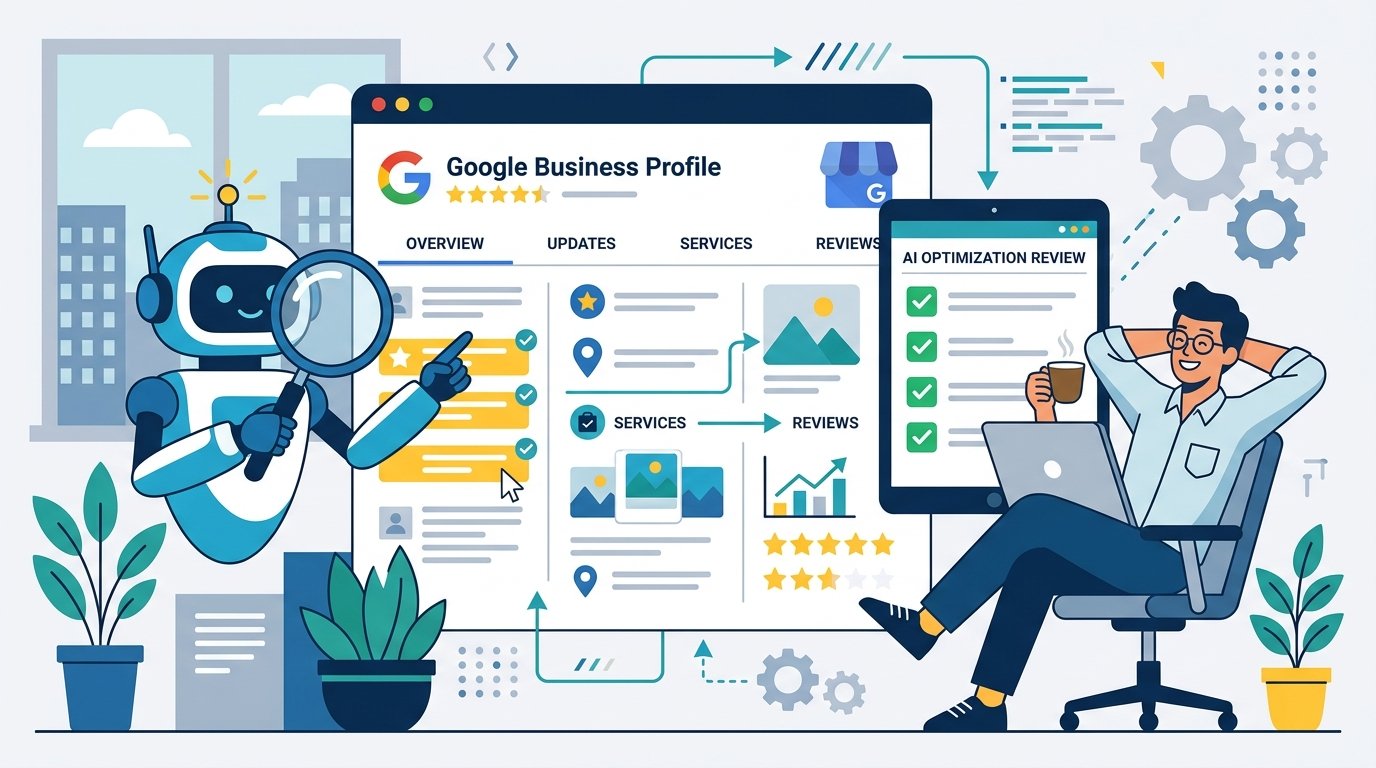
An AI agent can audit your Google Business Profile (GBP) on a weekly schedule, compare current profile data against known ranking signals, and queue a prioritized list of fixes for your review — without requiring a single manual audit session.
For founders and lean teams, that distinction matters. GBP is not a “set it once” asset. Google updates its local ranking factors regularly, profile completeness decays as business details change, and competitors push new photos, posts, and reviews every week. Keeping pace manually is a real time cost. A recurring automated audit removes that cost while keeping a human in control of every change.
Why GBP Keeps Slipping Without Ongoing Attention
Google Business Profile (GBP) is the listing that appears in Google’s local pack — the map-and-three-results block at the top of location-based searches. It is free to maintain, but its ranking signals are dynamic. The profile elements that influence local pack placement include business category accuracy, keyword relevance in the business description, photo freshness, post frequency, and the volume and recency of reviews.
The problem for lean teams is not knowing what to optimize — it is finding time to check it consistently. Most guides treat GBP as a one-time setup checklist. In practice, descriptions go stale, categories drift out of alignment with new services, photos age, and review responses pile up unanswered. BrightLocal’s Local Consumer Review Survey 2026 found that 74% of consumers only trust reviews written in the last three months, and 47% won’t use a business with fewer than 20 reviews. Those thresholds require active maintenance — not a setup checklist.
Beyond traditional search, GBP data is increasingly feeding AI-generated answers. The same BrightLocal research found that use of ChatGPT and other AI tools for local business recommendations surged from 6% to 45% year-over-year, making AI tools the third most popular source of local business recommendations. Incomplete or outdated GBP data means a business can be invisible to both the local pack and AI-generated local answers simultaneously.
The Five Elements That Decay Fastest
- Primary and secondary categories — Google adds new category options regularly; a category that was the closest fit a year ago may now be imprecise.
- Business description — Keyword relevance and clarity matter. Descriptions often go untouched after initial setup even as the business evolves.
- Photos — Google treats fresh photos as a signal of active management. Profiles with recent photo uploads show higher engagement rates.
- Google Posts — Posts expire after seven days for most business types. An unpopulated posts section signals inactivity.
- Review velocity and response rate — Review recency and owner response behavior affect both consumer trust and ranking signals.
How a GBP Optimizer Agent Works
A GBP Optimizer agent connects to your Google Business Profile via OAuth — your platform credentials are never stored — and reads current profile data on a weekly cadence. It compares what it finds against a predefined rubric: completeness scores for each profile section, keyword density in the description, photo count and recency, post cadence gaps, and unanswered reviews.
The output is a prioritized action list, not a live edit. This distinction is important for brand safety. The agent identifies that your primary category may be under-specified, that your description hasn’t been updated in 90 days, or that you have three unanswered reviews from the past week — and surfaces those findings for a human to act on. Nothing changes on the live profile without explicit approval. This is the same human-in-the-loop model that governs every action in mktcrew’s full agent crew: agents draft and recommend, people decide.
What the Weekly Audit Surfaces
A well-structured GBP audit queues recommendations across several areas:
- Category gaps — flags when primary or secondary categories are missing or when newer, more specific categories are available
- Description optimization — highlights keyword opportunities and identifies descriptions that haven’t been refreshed within a set threshold
- Photo health — counts current photos by type (interior, exterior, product, team) and flags when any category is stale or missing
- Post cadence — notes the gap since the last Google Post and drafts a suggested post for review
- Review monitoring — surfaces unanswered reviews and drafts suggested responses in brand voice, queued for human approval before sending
- Attribute completeness — checks that service-specific attributes (payment methods, accessibility features, hours for each day) are filled in accurately
The prioritized output means a founder or a marketing generalist can spend ten minutes per week on GBP rather than an hour on a full manual audit — while actually catching more issues because the agent runs consistently, not just when there’s bandwidth.
GBP Optimization and AI Search Visibility
One gap in most GBP guides is the link between profile quality and AI-generated local answers. When ChatGPT, Perplexity, or Google’s AI Overviews generate a local business recommendation, they draw on the same structured data that powers the local pack: name, category, address, phone, hours, and description.
A profile with an incomplete or keyword-poor description, no recent posts, and stale photos provides weaker structured signals to those AI systems than a well-maintained one. This is why an automated GBP audit is not just a local SEO task — it is part of a broader AI visibility strategy for lean teams. The GBP Optimizer runs alongside the AI Visibility Monitor, which queries AI search engines monthly to check whether your brand appears in answers to buyer-intent questions. Together, they give lean teams a complete picture of local and AI search presence without requiring a dedicated local SEO resource.
Connecting GBP Work to the Broader Marketing Cadence
An isolated GBP audit is useful. A GBP audit that feeds into a weekly marketing workflow is more useful. When the GBP Optimizer surfaces a category gap or a stale description, that signal can inform the content team — for example, a keyword that belongs in the GBP description may also belong in a blog article or a Google Post. In a crew-based model, those connections happen automatically: the same brand profile that steers the GBP Optimizer also steers the Writer, the Scout, and the Repurposer, so profile updates and content production stay aligned.
The Practical Difference for Lean Teams
For a solo operator or a two-person marketing team, the practical benefit of an automated GBP audit is not sophistication — it is consistency. Manual audits happen when there’s time. Weekly agent runs happen regardless. The profile stays current, review responses don’t pile up for three weeks, and photo freshness doesn’t require a calendar reminder.
The agent does not replace the human decision about which edits to make. It removes the overhead of knowing when to check, what to look for, and which gaps matter most. That’s the job that falls off the plate first for lean teams — and the job that compounds in cost when left undone.
Maintaining an optimized Google Business Profile is not a one-time task — it is a recurring operational obligation that a weekly AI audit handles systematically, surfacing prioritized recommendations for human review rather than asking lean teams to carve out time for a manual session every time Google updates its local ranking factors.