June 14, 2026
AI Agents for Paid Advertising: How Automated Campaign Management, Bid Optimization, and Creative Testing Work Inside a Marketing Crew
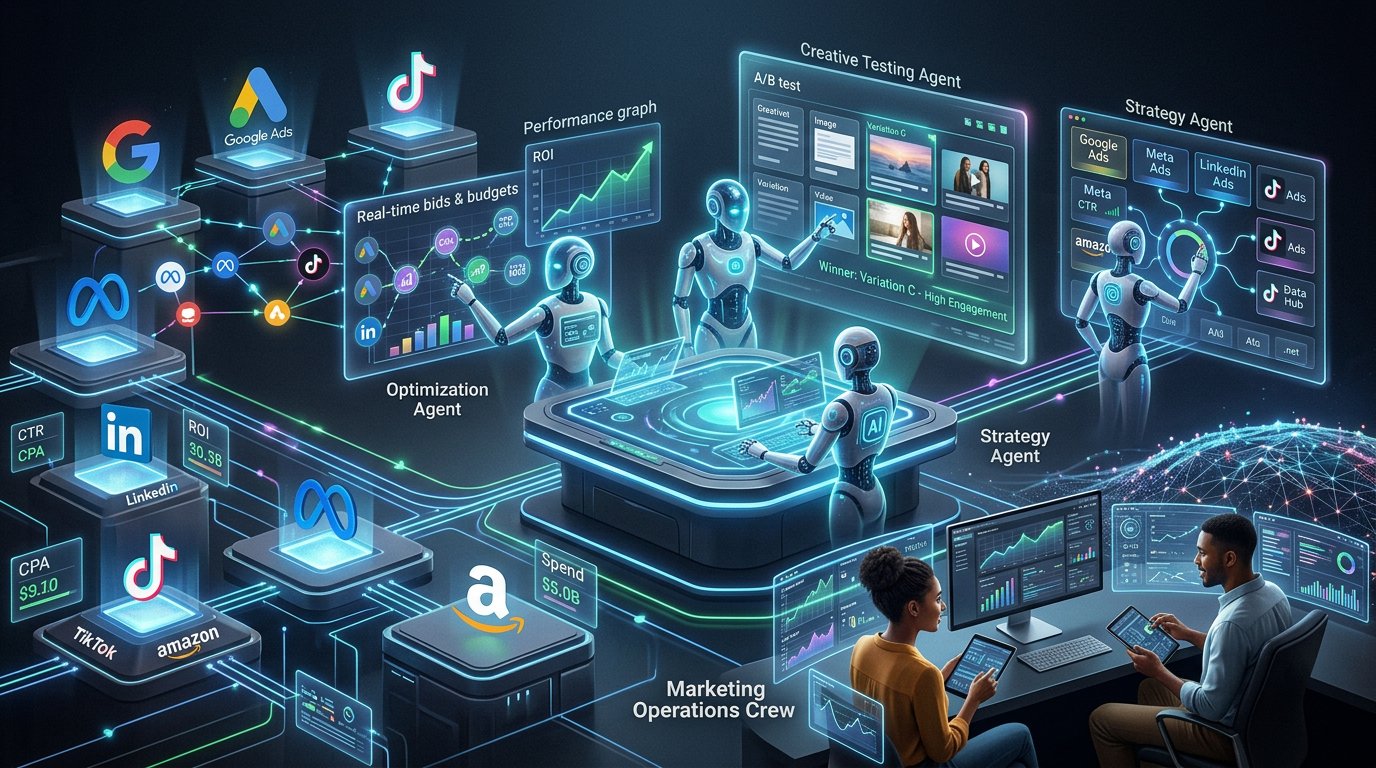
Most conversations about AI in paid advertising start and end in the same place: a platform’s native smart-bidding toggle. Google’s Smart Campaigns, Meta’s Advantage+, LinkedIn’s Accelerate — these features are genuinely useful, but they are confined to a single channel and a single objective. They optimize within a walled garden and share nothing with the rest of your marketing operation.
A different model is emerging. When a dedicated AI ads agent operates as part of a coordinated marketing crew — alongside content, SEO, social, and reporting agents — the scope of what automation can accomplish expands dramatically. The agent isn’t a feature inside an ad platform; it’s a purpose-built team member that receives briefs, executes across channels, feeds insights back into the crew, and never commits a dollar of spend without a human signing off first. This article walks through exactly how that works.
What a Dedicated AI Ads Agent Actually Does
The most important distinction to make upfront is scope. A platform-native AI bidding tool manages bid adjustments within that platform. A dedicated AI ads agent manages the full campaign lifecycle — and it does so across channels simultaneously.
In practice, this means the agent handles:
- Campaign setup: Translating a marketing brief into structured campaigns, ad groups, and targeting parameters across multiple channels — paid search, paid social, display, and beyond — based on audience data already held in the crew’s shared data layer.
- Audience targeting: Identifying and segmenting audiences by combining first-party data from connected integrations with behavioral signals gathered during campaign execution. As audiences respond, the agent updates segments accordingly.
- Bid optimization: Continuously evaluating performance signals — cost per click, conversion rate, impression share, return on ad spend — and adjusting bids in near real time to allocate budget toward the combinations that are performing best, pulling back from those that aren’t.
- Budget reallocation: Shifting spend across campaigns and channels based on live performance, so a budget doesn’t sit idle in an underperforming campaign while a high-performing one is starved of funds.
- Cross-channel coordination: Because the agent isn’t tied to one platform, it can recognize that a paid search campaign and a paid social campaign are targeting the same audience at the same stage of the funnel, and calibrate accordingly to avoid overlap or capitalize on sequencing.
None of this requires constant manual input. The agent reasons through options, makes decisions, and queues proposed changes — but those changes do not go live until a human approves them. More on that in a moment.
How the Ads Agent Fits Into the Marketing Crew
This is where the multi-agent model separates itself most clearly from standalone advertising tools. The AI ads agent doesn’t operate in isolation; it shares a common data layer with every other agent in the crew.
Consider the workflow from brief to result:
- The content agent produces a new campaign asset — a landing page, a product announcement, an offer — and passes the brief to the ads agent, including audience intent signals gathered during content research.
- The ads agent picks up the brief, builds the campaign structure, drafts ad creatives in multiple variations for testing, sets targeting parameters, and queues the whole package for human review.
- A human marketer reviews and approves the creative batch, the audience configuration, and the initial budget allocation before anything goes live.
- Once live, the ads agent monitors performance continuously. High-converting audience segments, top-performing headline copy, and efficient bid ranges are logged to the shared data layer in real time.
- The reporting agent pulls those signals and surfaces them in performance dashboards, and the SEO and content agents can read them too — discovering, for example, that a particular value proposition phrase is converting strongly in ads and should be prioritized in organic content as well.
- If the agent detects a meaningful change — say, a campaign is hitting budget limits while conversion rates are climbing — it prepares a budget reallocation proposal and routes it for human approval before acting.
This feedback loop is something no single-platform AI tool can replicate, because those tools are architecturally isolated. The ads agent’s performance data never leaves the platform it lives in, and organic teams never benefit from what paid campaigns learned. In a multi-agent crew, those walls don’t exist.
Human Approval as a Feature, Not a Workaround
A common concern about AI managing ad spend is accountability: who is responsible when an autonomous system moves budget or launches a creative that misses the mark? In a well-designed multi-agent system, human approval isn’t a reluctant concession to caution — it’s a structural feature of how the crew operates.
The approval mechanism surfaces at every significant decision point in the ads workflow:
- Creative approval: Before any ad creative goes live, a human reviewer sees the full set of variations the agent has prepared — headlines, body copy, visuals, call-to-action combinations — and can approve, reject, or edit individual elements.
- Audience approval: If the agent proposes a new audience segment or a significant shift in targeting — for instance, expanding to a lookalike audience based on recent converter data — that change is queued for human sign-off.
- Budget decisions: Any reallocation above a defined threshold triggers a review request. The agent presents its reasoning — which campaigns are outperforming, which are underperforming, and by what margins — so the human can make an informed decision rather than approving blindly.
- Campaign launch: A new campaign, regardless of how it was built, requires explicit human approval before the first impression is served.
This structure means that organizations retain strategic control over their paid media programs even as the agent handles the operational complexity. Teams can configure the approval thresholds to match their risk tolerance: a startup running its first campaigns might want approval on every bid change, while an enterprise team with established benchmarks might only need to review major structural decisions.
The result is a genuinely collaborative model. The AI ads agent handles the volume and speed that humans can’t match — monitoring thousands of bid auctions, analyzing creative performance across dozens of variations, spotting cross-channel inefficiencies — while humans retain the judgment calls that matter most.
Running Ads, Content, SEO, Social, and Reporting Under One Subscription
One structural advantage that gets little attention in existing coverage of AI advertising tools is the total cost of coordination. Most organizations using AI for paid advertising today do so through a patchwork of point solutions: a native platform AI here, a third-party bid management tool there, a separate analytics platform somewhere else. Each integration creates data friction. Each contract adds overhead. And none of them talk to the content team.
A crew-based model collapses that stack. One subscription covers the ads agent alongside the content, SEO, social, and reporting agents — all sharing a common data layer, all connected to the organization’s existing integrations. The ads agent benefits from content briefs without a manual handoff. The content team benefits from ad performance signals without a manual export. The reporting agent aggregates performance across every channel without a custom integration project.
For organizations of any size — from startups running lean to enterprises coordinating complex multi-market campaigns — this unified architecture removes the friction that typically slows down paid advertising programs: delayed data, siloed insights, and the operational overhead of managing multiple vendor relationships.
Putting It Together
AI agents for paid advertising represent a meaningful shift from the platform-native smart-bidding features that define the current conversation. A dedicated ads agent, operating as part of a coordinated marketing crew, handles the full campaign lifecycle across channels — setup, targeting, bid optimization, creative testing, and budget reallocation — while sharing performance signals with every other agent in the crew in real time.
What makes this model practically viable for real marketing teams is the human approval layer embedded at every significant decision point. Spend isn’t committed and creatives don’t go live without a human sign-off, which means organizations keep strategic control even as the agent absorbs the operational complexity. The crew-based subscription model further simplifies adoption by replacing a fragmented stack of point solutions with a single, integrated team of agents that works with your existing tools from day one.
Frequently Asked Questions
Can AI agents fully automate paid advertising campaigns?
An AI ads agent can autonomously manage campaign setup, audience targeting, bid optimization, creative testing, and budget reallocation. However, in a well-designed crew model, human approval is always required before spend is committed or creatives go live, ensuring the organization retains strategic control throughout.
How does an AI agent optimize ad bids without constant human input?
The agent continuously monitors performance signals — conversion rates, cost per acquisition, impression share, and return on ad spend — across active campaigns and adjusts bids in near real time based on that data. Significant changes are queued for human review rather than applied automatically, so optimization happens at machine speed with human oversight at the decision points that matter.
What separates a multi-agent marketing crew from Google’s Smart Bidding or Meta’s Advantage+?
Platform-native AI bidding tools are confined to a single channel and cannot share insights with the rest of your marketing operation. An AI ads agent within a marketing crew operates across multiple channels simultaneously and feeds performance signals — high-converting copy, efficient audience segments — back to the content, SEO, and reporting agents, so organic and paid strategies reinforce each other.
How does AI automate A/B testing for ad creatives?
The ads agent generates multiple creative variations — testing different headlines, body copy, and calls to action — and submits the full set for human approval before launch. Once live, it monitors which combinations perform best and surfaces those findings to the broader crew, so successful messaging can be replicated across other marketing channels.
Can one subscription cover ads, content, SEO, social, and reporting together?
Yes. A crew-based subscription model deploys AI agents across all core marketing functions — ads, content, SEO, social, and reporting — sharing a common data layer and connecting to your organization’s existing integrations, replacing the fragmented stack of point solutions most teams currently manage.