September 2, 2026
From Blog Post to LinkedIn, Instagram, and X: How AI Agents Repurpose Content Across Channels
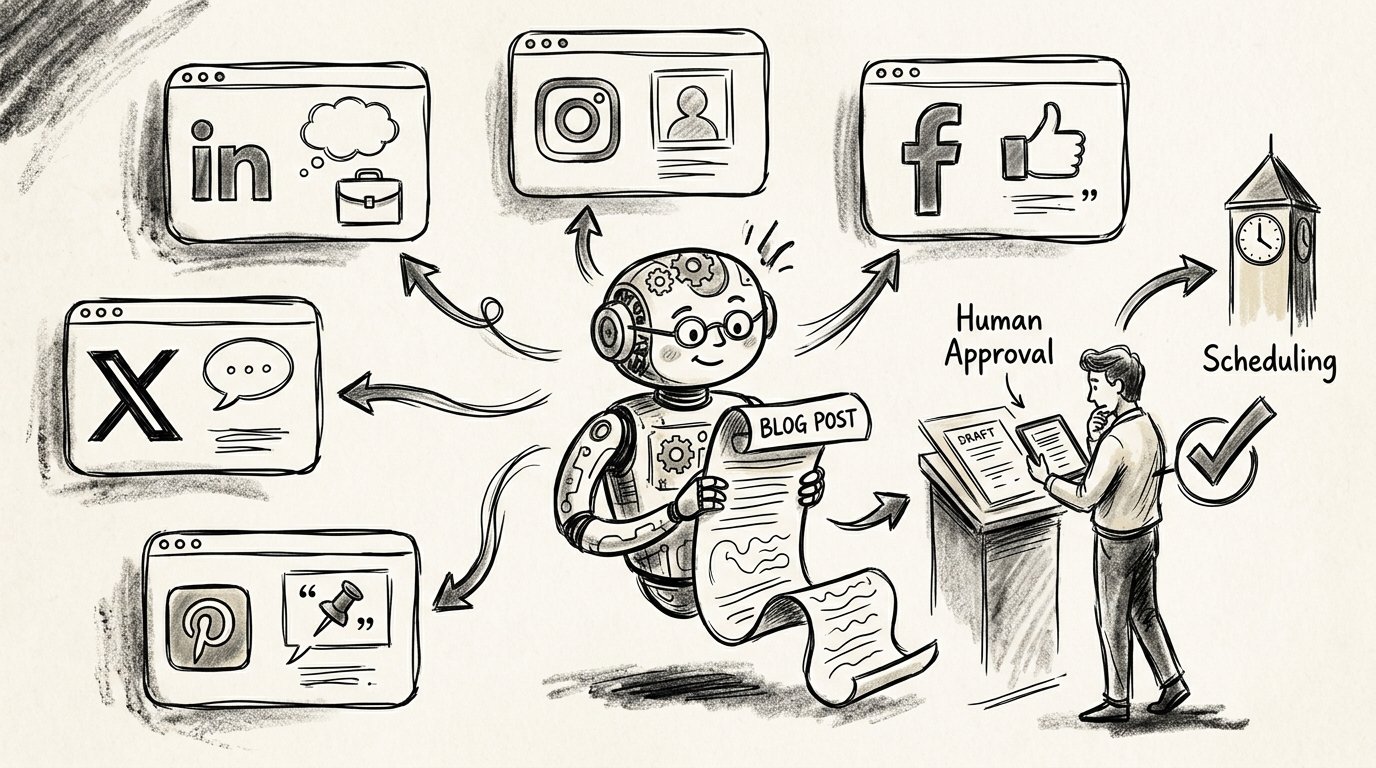
A single approved blog post can generate five or more channel-ready social posts — without a social media manager — when AI agents handle the per-platform adaptation and a human approves each draft before it schedules.
That ratio isn’t theoretical. Buffer’s content team documents a “5-to-1 rule” as a practical benchmark: aim for at least five social posts from every long-form piece. For a founder or lean team already producing one article a week, that’s a full week of social content from work that’s already done. The bottleneck isn’t ideas — it’s the manual labor of reformatting and rewriting for each platform. That’s exactly where AI agents close the gap.
Why Platform-Specific Adaptation Is the Hard Part
Cross-posting the same text to every channel is not repurposing. It’s the fastest way to underperform on all of them.
Each platform has a distinct content contract with its audience:
- LinkedIn rewards professional framing, longer narrative paragraphs, and explicit takeaways for a B2B audience. A post that opens with a data point and closes with a strategic implication performs reliably.
- Instagram is visual and caption-driven. A carousel breaks an article’s key steps into swipeable slides; a single-image post pairs a punchy one-liner with a strong visual hook.
- X (Twitter) favors brevity and debate. The sharpest stat or most provocative claim from the article, stated in one sentence, tends to drive replies and engagement better than a summary.
- Facebook sits in the middle — slightly warmer tone, often benefits from a question to invite comments, and performs well when the post feels conversational rather than broadcast.
Manually rewriting a 1,000-word article into four distinct formats — matching each platform’s tone, character limits, and audience expectations — takes 60 to 90 minutes on a good day. For a solo founder or a two-person marketing team, that’s a weekly task that routinely slips.
AI agents eliminate the rewrite time. A Repurposer agent reads the finished article, pulls out the central argument, supporting data, and key quotes, then produces distinct drafts for each channel in the correct format and voice. It doesn’t summarize — it adapts. The LinkedIn draft reads like LinkedIn. The X draft reads like X.
Tone Is Not Optional
The tone gap across platforms is significant enough that identical content reads as off-brand or spammy when dropped into the wrong channel. A case study that works as a LinkedIn narrative will land flat on Instagram without a visual hook. A thread opener that works on X will feel abrupt if pasted into a Facebook post with no context.
Effective AI-agent repurposing encodes platform-specific tone rules into the agent’s instructions — not as vague guidance like “be more casual,” but as structural rules: word count ceiling, opening format, whether to include a CTA, and how to handle statistics. This is what separates channel-specific repurposing from glorified copy-pasting.
How the Approval-First Workflow Actually Runs
The most common concern with AI-generated social content is brand risk: what if the agent posts something off-message, factually garbled, or tonally wrong? The answer is that nothing should post without a human decision — and a well-designed system enforces that structurally, not just as a policy.
Here is how a human-in-the-loop repurposing workflow runs in practice:
- Article approved. The blog post has already cleared an editorial review and been approved for publication. The Repurposer agent is triggered on approval.
- Channel drafts generated. The agent produces one draft per enabled channel — LinkedIn, Instagram, Facebook, and X — each formatted for that platform.
- Drafts queue for review. Every draft lands on a social calendar as a pending item. Nothing is scheduled or posted automatically.
- Human reviews and approves. The editor or founder reads each draft, edits inline if needed, and approves or skips. Approved posts move to the calendar; skipped posts are discarded or revised.
- Social Scheduler publishes on time. Once approved and scheduled, a separate scheduler agent publishes at the chosen time. It will not post anything that hasn’t gone through the approval step.
This structure means the AI handles the time-consuming adaptation work while the human retains full editorial control over what actually reaches the audience. The two jobs — creation and approval — are cleanly separated.
Connecting the Flow to a Content Calendar
The repurposing workflow only delivers consistent output when it’s tied to a schedule, not triggered ad hoc. When a new article publishes every week, the Repurposer runs every week, and five social drafts appear on the calendar every week. The team’s job shrinks from “write social content” to “review and approve social content” — a much lighter lift.
For teams using mktcrew’s AI marketing crew, this entire flow — article drafted, edited, published to CMS, repurposed into social drafts, queued for approval — runs on a weekly cadence without manual coordination. The Repurposer agent specifically handles the channel-specific adaptation step, and nothing reaches a live channel without an explicit approval decision.
What a Solo Operator or Small Team Actually Gets Back
The practical output of an AI repurposing workflow isn’t just time saved — it’s consistent multi-channel presence that was previously impossible without a dedicated social media manager.
A team producing one article per week can realistically maintain:
- Four active social channels with channel-native content
- A full week’s worth of posts from a single creative asset
- A review-only workload that takes 15–20 minutes per week rather than 90 minutes of rewriting
The content quality gap between AI-adapted posts and manually written ones closes quickly when the agent is given clear platform rules and the brand profile is specific enough. Generic instructions produce generic output; detailed tone and format rules produce drafts that need minor edits rather than full rewrites.
Repurposing also extends the value of every article beyond its publish week. A post from a strong-performing article can be re-queued months later with a new angle. The original investment in research and writing keeps compounding across channels and time — without additional creative effort.
Getting Started Without a Social Media Manager
The entry point is simpler than most teams expect. You don’t need a dedicated social media manager or a complex multi-tool stack. What you need is a finished article and an agent configured with platform-specific rules tied to your brand voice.
If your current workflow produces articles but stops at the blog, the repurposing step is the highest-leverage addition you can make. One article becomes five posts. One approval session covers a full week. And nothing goes live until you’ve read it and said yes.
That’s not a workaround for a lean team — it’s a better system than most fully-staffed marketing departments are running.