September 4, 2026
How AI Agents Run Weekly Competitor Monitoring So You Never Miss a Rival’s Move
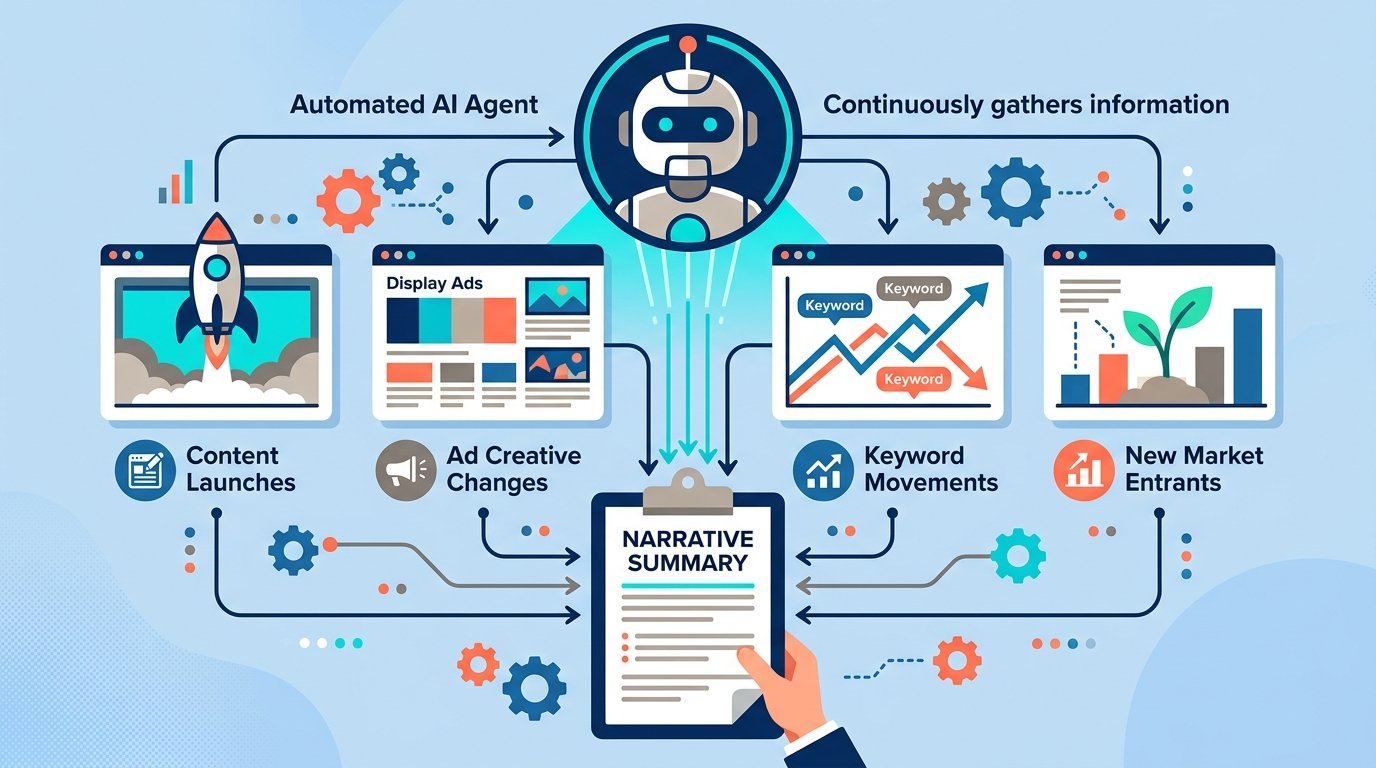
AI agents can run weekly competitor monitoring automatically — tracking rival content launches, ad creative changes, keyword movements, and new market entrants — then delivering a narrative summary without anyone logging into a tool manually.
For a small team or a founder doing their own marketing, this matters. According to Crayon’s 2026 State of Competitive Intelligence report, 57.5% of teams say more of their deals are competitive than a year ago. Yet only about half of those teams share competitive intel on a weekly cadence — the frequency most correlated with positive revenue impact. The gap between tracking competitors and acting on that intelligence consistently is where lean teams lose ground.
Why Manual Competitive Monitoring Breaks Down for Small Teams
A one-off competitive analysis — where someone spends a morning in a research tool, builds a spreadsheet, and files it away — has a short shelf life. Competitors publish new blog posts, test fresh ad copy, shift messaging on landing pages, and enter adjacent keyword categories every week. A snapshot from last quarter is rarely useful when a prospect asks why you’re different from a rival that just launched a new feature.
Manual monitoring also doesn’t scale with team size. If the person doing the research is also running campaigns, writing content, and managing the social calendar, competitive tracking becomes the first thing that gets dropped. The result is inconsistent coverage: deep dives when there’s time, nothing for weeks when there isn’t.
Three specific gaps appear most often on lean teams:
- New competitor discovery — Most teams monitor the rivals they already know. They have no systematic way to surface a new entrant that starts ranking for their target keywords or appearing in AI-generated answers.
- AI search visibility — A competitor could be getting cited by ChatGPT or Perplexity for the exact questions your buyers are asking. Without a monitoring process specifically aimed at AI search engines, this blind spot goes undetected.
- Synthesis lag — Even teams that gather competitive data rarely turn it into a clear, prioritized summary that a founder or marketer can act on without further analysis.
What a Weekly AI Agent Monitoring Cadence Covers
AI agents built for competitive intelligence run on a fixed schedule and cover the categories that change most frequently: content and messaging, paid advertising, and new market entrants. The key difference from one-off analysis is continuity — the same checks run every week against a consistent set of tracked domains and topics.
Content and Messaging Shifts
A competitor monitor agent crawls rival websites weekly and flags changes: new blog posts, updated product pages, revised positioning copy, and published case studies. This catches the pattern that’s easy to miss manually — a competitor quietly shifting from “affordable” language to “enterprise-grade” language over a few weeks, for example. Seeing that drift early informs your own positioning before it creates a conversion problem.
Paid Ad Creative and Keyword Movements
Ad copy and keyword targeting change faster than most teams expect. Agents that sync with ad intelligence signals can surface when a rival starts bidding on new terms or refreshes their creative — context that’s useful when reviewing your own campaign recommendations. Importantly, surfacing this intelligence is observation only: mktcrew’s ad optimizer agents provide evidence-backed recommendations without ever touching live campaign settings.
New Competitor Discovery
This is the gap almost no manual process covers well. A Competitor Discovery agent monitors keyword rankings, industry news, and AI-generated answer sets to surface domains that weren’t on your radar before — startups gaining traction in your category, adjacent products expanding into your market, or funded companies entering a related space. Getting an alert about a new entrant when it has 200 monthly visitors is more useful than discovering it when it has 20,000.
AI Search Visibility
One of the least-tracked competitive signals is whether a rival is getting mentioned by name in AI-generated answers — ChatGPT, Perplexity, and similar engines. If a competitor’s brand or product appears in the answers your buyers see when they ask “what’s the best [tool category] for [use case],” that’s a meaningful reach advantage. An AI Visibility Monitor that queries AI search engines monthly and compares your mention rate against category-level patterns gives lean teams a signal they couldn’t track manually at all.
From Raw Intelligence to a Weekly Summary You Can Actually Use
Gathering data is the easier half of competitive monitoring. The harder part is synthesis — turning a week’s worth of crawled pages, ad signals, and keyword movements into a short, prioritized narrative that a founder or a two-person marketing team can review and act on without spending two hours on it.
This is where the narrative summary step matters. Rather than a raw list of competitor page changes, a well-designed agent compiles a digest: what changed, why it might matter, and what — if anything — warrants a response. The Crayon report found that 82% of teams running AI agents in their competitive intelligence program achieve positive revenue impact, compared to 42% of teams that don’t. The agent isn’t just automating data collection; it’s reducing the interpretation overhead that makes most CI programs stall.
The human-approval layer stays intact throughout this process. Competitive intelligence agents surface findings and flag potential responses — a content gap worth covering, a keyword cluster worth targeting — but nothing gets published, posted, or bid on automatically. A team member reviews the summary, decides what to act on, and approves any downstream work. This keeps competitive response thoughtful rather than reactive, and it means a small team can maintain a consistent monitoring cadence without the risk of automated counter-moves that haven’t been reviewed.
Putting It Into Practice Without a Dedicated Analyst
The practical setup for a lean team looks like this: define a set of known competitors in your brand profile, specify the keyword categories and topics you care about, and let the agents run on their weekly schedule. By the time the weekly summary lands in your inbox or dashboard, the crawling, synthesis, and formatting is already done.
The first weekly report typically reveals more than teams expect — rivals covering topics they assumed were uncontested, ad creative that mirrors their own messaging, or a new entrant already indexing for high-intent terms. That visibility, delivered consistently, is what makes competitive monitoring useful rather than occasional.
For founders and small marketing teams, the argument for automation here is straightforward: the competitive landscape moves on a weekly cadence whether or not your monitoring does. Agents that match that cadence mean the intelligence is always current — and always ready when a prospect, an investor, or a product decision needs a clear answer about where you stand.