June 22, 2026
What an AI SEO Agent Actually Does: Automated Keyword Research, Technical Audits, and Content Brief Generation Inside a Marketing Crew
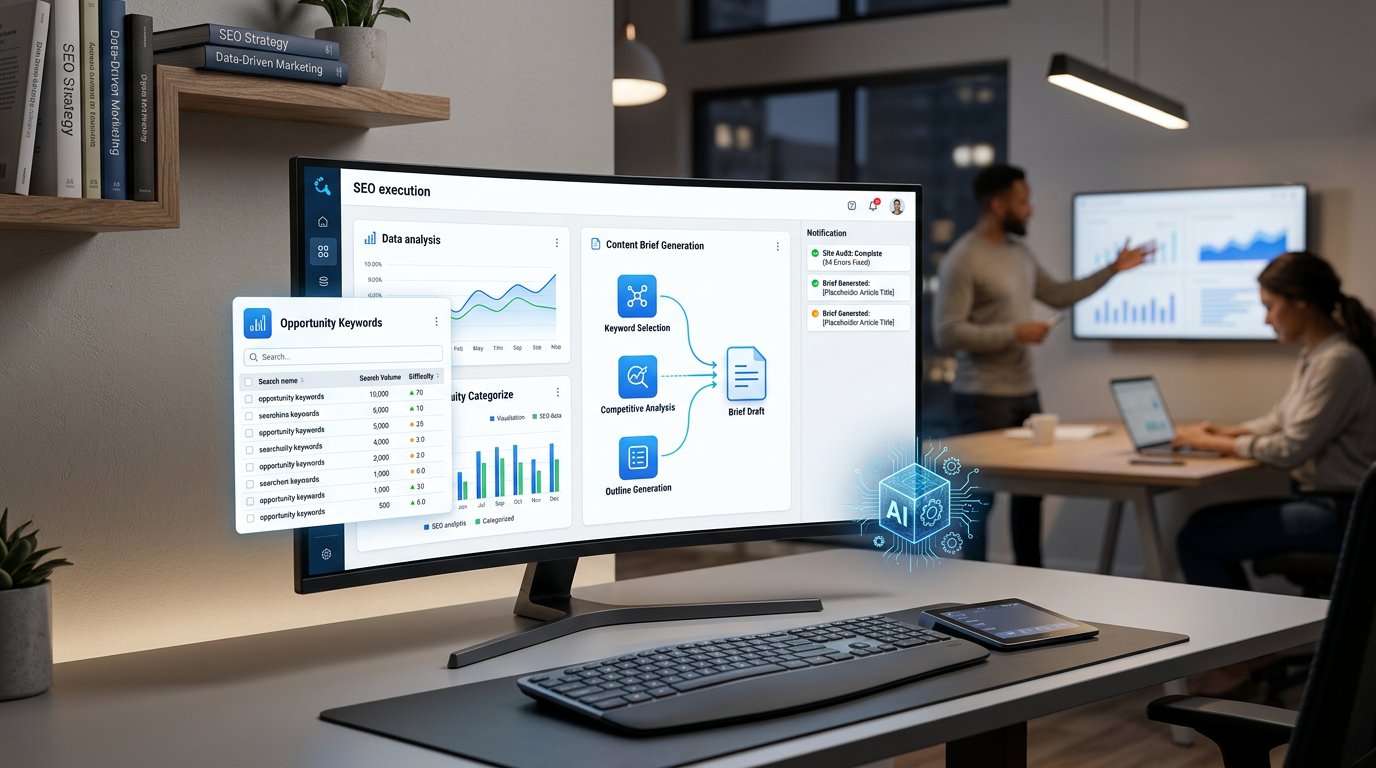
Most marketing teams treat SEO tools as sophisticated search engines: you log in, run a query, read the results, decide what matters, and then — manually — do something about it. Tools like Ahrefs and Semrush have layered AI features on top of this model, but the fundamental workflow remains human-activated. Someone has to notice the ranking drop, open the dashboard, pull the report, and write the brief. That human orchestration at every handoff is where SEO-to-content pipelines stall, opportunities age out, and competitive gaps stay open longer than they should.
A dedicated AI SEO agent inside a coordinated marketing crew works differently. Rather than waiting to be queried, it operates continuously — surfacing keyword opportunities on a schedule, running technical audits without a developer’s prompt, and generating structured content briefs that flow directly to the content agent for draft production. Every consequential output still passes through a human approval gate before any agent acts on it, but the manual labor of connecting the dots disappears. Here is what that actually looks like in practice.
Autonomous Keyword Research: From Passive Tool to Proactive Crew Member
The defining difference between an AI SEO tool and an AI SEO agent is initiative. A tool answers questions. An agent asks them independently and surfaces the answers on its own schedule.
In a multi-agent marketing crew, the SEO agent continuously monitors keyword opportunity signals — search volume shifts, emerging topic clusters, competitor ranking changes, and SERP volatility — without waiting for a human to open a dashboard. When it identifies a cluster worth pursuing, it doesn’t produce a raw data export. It generates a prioritized target list with intent classification, estimated competitiveness, and a rationale, then queues that list for a single human approval session before anything moves forward.
This matters because keyword opportunity has a shelf life. A trending topic cluster that surfaces today may be well-covered by competitors within weeks. When the discovery-to-decision pipeline depends on someone remembering to check a tool, the window closes. An SEO agent operating on a defined schedule closes that window automatically, ensuring the crew can act while the opportunity is fresh — pending, always, the human sign-off that confirms the direction is right for the business.
The contrast with the conventional model is also structural. Traditional AI-assisted SEO platforms position AI as a human-activated helper: suggest seed keywords, analyze SERP intent, brainstorm headers. Each of those steps requires a human to prompt the tool, evaluate the output, and carry the result to the next step. A dedicated SEO agent inside a marketing crew collapses those steps into a single autonomous cycle, reserving human attention for strategy and approval rather than step-by-step execution.
Continuous Technical Audits and Intelligent Task Routing
Technical SEO is where the gap between a tool and an agent is most visible — and most costly when left unaddressed.
A conventional audit platform generates a report. A crawl error dashboard sits there until someone opens it. Core Web Vitals issues, broken internal links, schema markup failures, and missing canonical tags accumulate in a queue that competes with every other priority on the marketing team’s plate. The problems are visible, in theory. Acting on them requires a human to triage, prioritize, assign, and follow up.
An AI SEO agent running continuous technical audits does not stop at detection. When it identifies a crawl error, it doesn’t add it to a report — it routes a remediation task to the appropriate agent or, where the fix requires human judgment (such as a structural redirect decision), it flags the item in the human approval queue. Core Web Vitals regressions trigger a structured report that the reporting agent can incorporate into the weekly performance summary. Schema issues queue as implementation tasks. Internal link gaps generate recommendations tied directly to the content pipeline, so new articles are created with the full internal linking context already baked in.
The practical effect is that the technical health of a site becomes a living, continuously-managed system rather than a periodic audit exercise. Issues are surfaced faster, routed to the right place automatically, and actioned — or held for human approval — without the team needing to orchestrate each step. For organizations running large content operations across multiple site sections, this continuous monitoring changes the operational calculus of technical SEO entirely.
Structured Content Briefs and the SEO-to-Content Handoff
Perhaps the most consequential thing a dedicated AI SEO agent does is eliminate the manual handoff between SEO intelligence and content production.
In most organizations today, SEO and content are separate workflows that share information imperfectly. An SEO specialist identifies a keyword opportunity, writes a brief (or doesn’t), and hands it to a content writer. The brief may lack SERP intent analysis, competitor content gaps, or suggested heading structure. The writer fills those gaps with their own research, or doesn’t. The published piece may rank, or it may not, and the root cause is often traceable to an incomplete brief that was nobody’s fault — just a consequence of the manual coordination overhead.
Inside a multi-agent marketing crew, the SEO agent generates a structured brief as a direct production input. That brief includes the target keyword and its intent classification, a competitor gap analysis drawn from current SERP data, suggested heading structure aligned with what top-ranking pages cover, internal linking recommendations, and technical metadata requirements. The brief is queued for human review and approval. Once approved, it passes directly to the content agent, which produces the draft from that structured input rather than starting from a blank slate.
The same mechanism applies to content refresh cycles. When the SEO agent detects a ranking drop on an existing page — a signal that the content may no longer match current SERP intent or has been outpaced by competitor updates — it generates a refresh brief automatically and queues it for approval, without requiring a human to notice the drop first and initiate the process.
This closed loop between SEO monitoring and content execution is what distinguishes a multi-agent SEO and content marketing platform from a collection of separate tools. The intelligence generated by the SEO agent becomes the production input for the content agent, with human oversight at the brief-approval stage ensuring that strategic direction is always confirmed before resources are committed.
Keeping Humans in Control of an Autonomous SEO Workflow
Automation at this level raises a reasonable question: where does human judgment fit when an agent is monitoring rankings, surfacing opportunities, running audits, and generating briefs on its own schedule?
The answer is a structured approval layer that batches consequential outputs for a single human review session rather than distributing oversight friction across every micro-step. A weekly approval queue might include a prioritized list of new keyword targets, two or three content briefs ready for commissioning, and a set of technical remediation tasks ranked by estimated impact. A human reviews, adjusts, approves, or declines each item. Only approved outputs move into the production pipeline.
This model preserves human authority over the decisions that matter — what to create, what to fix, what to prioritize — while removing the cognitive overhead of orchestrating the discovery-to-brief-to-draft pipeline manually. The crew of AI agents handles execution; the human handles direction.
It also scales cleanly across organizations of different sizes. A startup team with no dedicated SEO function gains continuous monitoring and structured brief generation without hiring. An enterprise team with existing SEO processes gains a layer of automation that eliminates the coordination overhead between SEO and content, freeing specialists to focus on strategy, brand positioning, and the judgment calls that agents cannot make.
Under one subscription, the SEO agent operates alongside content, social, advertising, and reporting agents — all connecting to an organization’s own integrations — so the intelligence generated by one function is immediately available to the others. The alternative is separate contracts for a keyword research tool, a technical audit platform, a brief template, and an SEO agency retainer, each producing outputs that a human must manually move between systems.
The gap between AI-assisted SEO and a truly autonomous AI SEO agent is not a matter of degree — it is a structural difference in where human attention is required. An agent-based approach does not ask marketing teams to work faster inside the same manual pipeline. It replaces the pipeline itself, with human approval retained at every decision that matters.