June 12, 2026
What an AI SEO Agent Actually Does: Keyword Research, On-Page Optimization, and Reporting on Autopilot
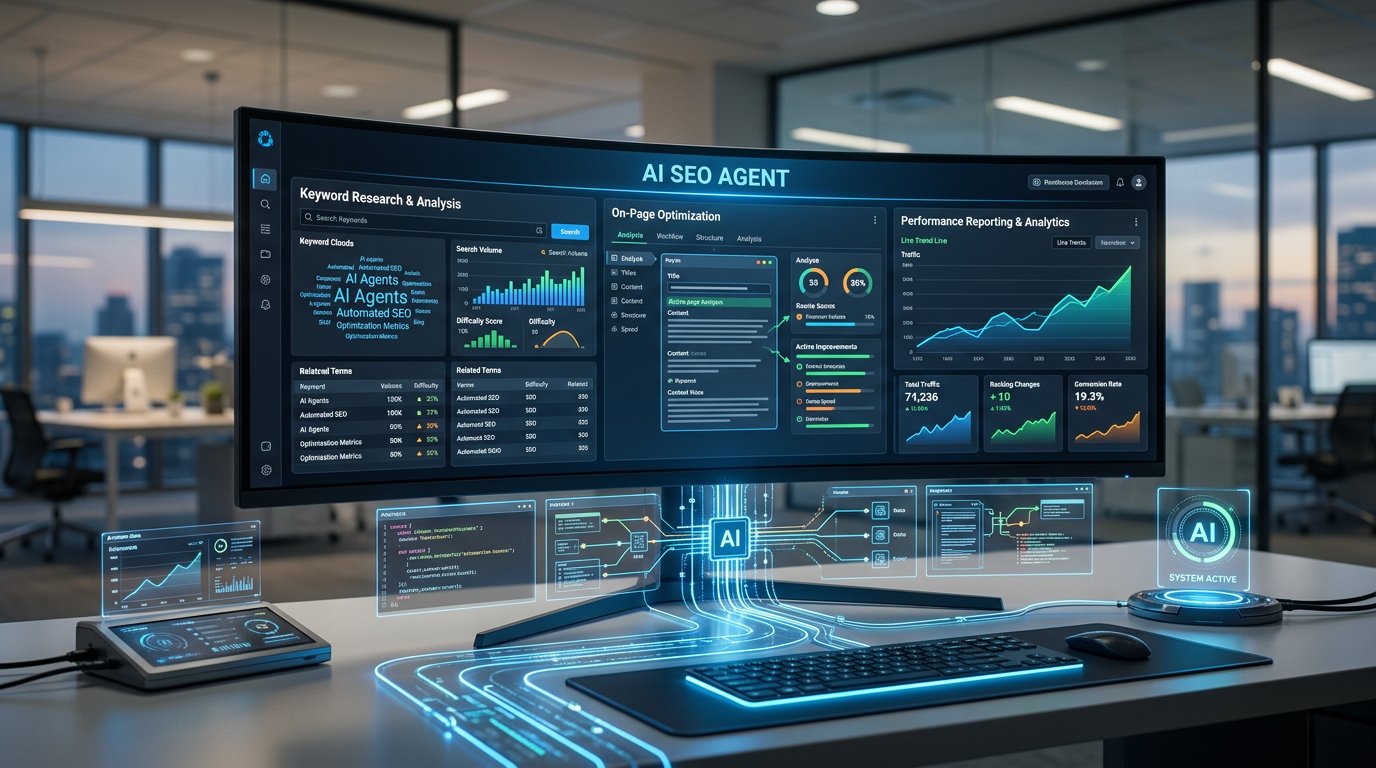
Most conversations about AI and SEO follow the same script: here is a prompt you can paste into ChatGPT to brainstorm keywords, here is another one to generate a meta description, and here is one more to outline a content refresh. Each task starts with a human opening a chat window, typing instructions, reviewing output, and then manually acting on it. That is a faster version of the old workflow — but it is still a human-driven, task-by-task workflow.
A dedicated AI SEO agent works differently. Rather than waiting to be prompted, it operates continuously inside a coordinated marketing crew, cycling through the full SEO lifecycle — keyword discovery, topic cluster planning, on-page optimization, internal linking, and performance reporting — and handing findings directly to other agents in the system. The distinction is not cosmetic. It changes what your team spends time on and how quickly opportunities get acted upon.
From Reactive Tool to Proactive Agent: What Actually Changes
A traditional SEO tool, whether AI-powered or not, is reactive. You supply a query and it returns data. You decide what to do next, open another tool, run another query, and repeat. The human is the connective tissue holding each step together.
A proactive AI SEO agent inverts that model. It monitors your site’s keyword rankings on an ongoing basis, detects when a page begins to lose position, identifies the likely cause — thin content, a keyword gap, a competing page gaining links — and initiates the appropriate response without waiting to be asked. When a cluster of pages shows declining visibility, the agent does not flag it for someone to investigate later; it surfaces a prioritized action queue and, where applicable, triggers a brief for the content agent to begin a refresh.
This is the difference between a calculator and a colleague. The calculator does exactly what you tell it. The colleague understands the goal, watches for problems, and brings you what matters.
The human is not removed from this picture — they are elevated within it. Every recommended action, from a batch of revised meta descriptions to a restructured internal linking map, is surfaced for approval before anything changes on the site. The agent handles the cycle; the human retains final authority over every deployment decision.
The Full SEO Cycle an AI Agent Runs Autonomously
Understanding what an AI SEO agent actually executes end-to-end makes the value tangible. Here is how the cycle runs:
Keyword discovery and gap analysis. The agent continuously scans your existing rankings alongside competitor positioning to surface keyword gaps — terms your competitors rank for that your site does not cover or covers inadequately. Rather than generating a static list for a human to sort through, it prioritizes gaps by estimated opportunity and maps each one to the existing site architecture to determine whether a gap should be filled by a new page or an update to an existing one.
Topic cluster planning. Isolated keywords rarely drive lasting authority. The agent groups related terms into topic clusters, identifies missing cluster pages, and determines which pillar pages need to be strengthened. This cluster map is handed directly to the content agent, which can then generate briefs for the pages with the highest priority — without requiring a separate request from the marketing team.
On-page optimization. For existing pages, the agent audits title tags, meta descriptions, header structures, and semantic keyword coverage against top-ranking competitors. Suggested updates — such as a revised title tag or an expanded H2 structure — are queued for human review before they go live. Bulk updates, like refreshing dozens of meta descriptions at once, are presented as a reviewable batch rather than as a hundred separate decisions.
Internal linking. As content is added or updated, the agent identifies new internal linking opportunities and flags broken or missing links. An up-to-date internal linking structure reinforces topic authority and helps search engines understand the relationship between pages — but maintaining it manually across a growing site is time-consuming. The agent keeps this map current automatically.
Performance reporting. The agent pulls ranking data, organic traffic trends, and crawl health signals into a structured report at regular intervals. Declining pages, crawl errors, and indexability issues are flagged proactively, with context about what changed and what actions are recommended. Because the reporting agent operates in the same crew, these findings feed back into the optimization queue without any manual data transfer.
How Human Approval Fits Into an Autonomous SEO Workflow
One of the questions that comes up quickly when organizations consider AI-driven SEO is control: if an agent is running the workflow autonomously, how does a team ensure that nothing goes live without review?
The answer is that human approval is a structural part of the workflow, not an optional add-on. Every output the SEO agent produces — revised meta descriptions, internal linking recommendations, content refresh briefs, keyword cluster maps — passes through an approval step before deployment. A human reviewer can accept, modify, or reject any recommendation. The agent handles the research, synthesis, and preparation; the human authorizes what goes live.
This is especially important at scale. When a site has hundreds of pages, the volume of potential optimizations can make it impossible for a small team to keep up using a manual process. An AI SEO agent structures that volume into prioritized, reviewable queues rather than an unmanageable backlog. The team spends time making decisions, not hunting for what needs attention.
For organizations with compliance or brand sensitivity requirements, this approval layer means that automated SEO execution does not mean unreviewed changes to customer-facing content. The crew moves fast; the human keeps the final word.
SEO, Content, and Reporting as a Connected System
Perhaps the most significant gap in current AI-for-SEO content is what happens at the boundaries. A standalone SEO tool can tell you that a page is losing rank and that a keyword gap exists. What it cannot do is automatically hand that insight to a content system that acts on it, and then feed the resulting performance data back into the SEO analysis to close the loop.
A multi-agent marketing crew is designed around those connections. When the SEO agent identifies a keyword gap, the content agent receives a brief. When the content agent publishes new material, the SEO agent updates its internal linking map and begins tracking the new page’s performance. When the reporting agent compiles its weekly summary, the SEO findings are included alongside social, ads, and content metrics — giving a complete view of marketing performance under one subscription rather than across five separate dashboards.
This integration is not just a convenience. It is what allows an organization of any size — from an early-stage startup with a two-person team to an enterprise managing thousands of pages — to run a coherent, continuously improving SEO program without scaling the team in proportion to the work.
Conclusion
The shift from AI-as-tool to AI-as-agent changes the nature of the work a marketing team does. Keyword research, on-page optimization, internal linking, and performance reporting do not have to be tasks that wait for a human to initiate them. A dedicated AI SEO agent runs that cycle continuously, hands its outputs to the right agents in the crew, and presents every significant decision to a human approver before anything changes on the site.
The result is an SEO program that keeps moving even when no one on the team is actively managing it — and one that gets smarter over time as the agents share what they learn across the full marketing operation.
Frequently Asked Questions
What does an AI SEO agent do differently from a traditional SEO tool?
A traditional SEO tool responds to human queries — you ask, it answers, and you decide what to do next. An AI SEO agent runs the workflow proactively, monitoring rankings, detecting issues, and triggering the right actions without waiting to be prompted. It also hands findings directly to other agents in the marketing crew, closing loops that a standalone tool leaves open.
What is the difference between an AI SEO tool and an AI SEO agent?
An AI SEO tool is software you operate; an AI SEO agent is a system that operates on your behalf. The tool helps you do tasks faster. The agent handles the tasks autonomously, surfaces prioritized recommendations, and integrates with the rest of your marketing operation — while always routing consequential decisions through a human approver.
How do you keep humans in control when using AI for SEO?
Human approval is built into the workflow at every deployment decision point. Recommended changes — from revised meta descriptions to content refresh briefs — are queued for review before anything goes live. The agent prepares; the human authorizes.
Can one AI platform handle SEO, content, and reporting together?
Yes — a multi-agent marketing platform deploys a crew of AI agents across SEO, content, social, advertising, and reporting under one subscription. Because the agents share context, SEO insights flow automatically into content briefs and reporting summaries without manual data transfer between tools.
Can AI fully automate keyword research and on-page SEO?
An AI SEO agent can autonomously run keyword gap analysis, prioritize opportunities, audit on-page elements, and prepare optimization recommendations. Full automation of deployment depends on human approval — which is the intended design, not a limitation. The agent handles the research and preparation cycle; a human reviewer decides what is applied.