August 16, 2026
Does Your Brand Show Up When People Ask ChatGPT, Perplexity, or Gemini? How to Find Out and Fix It
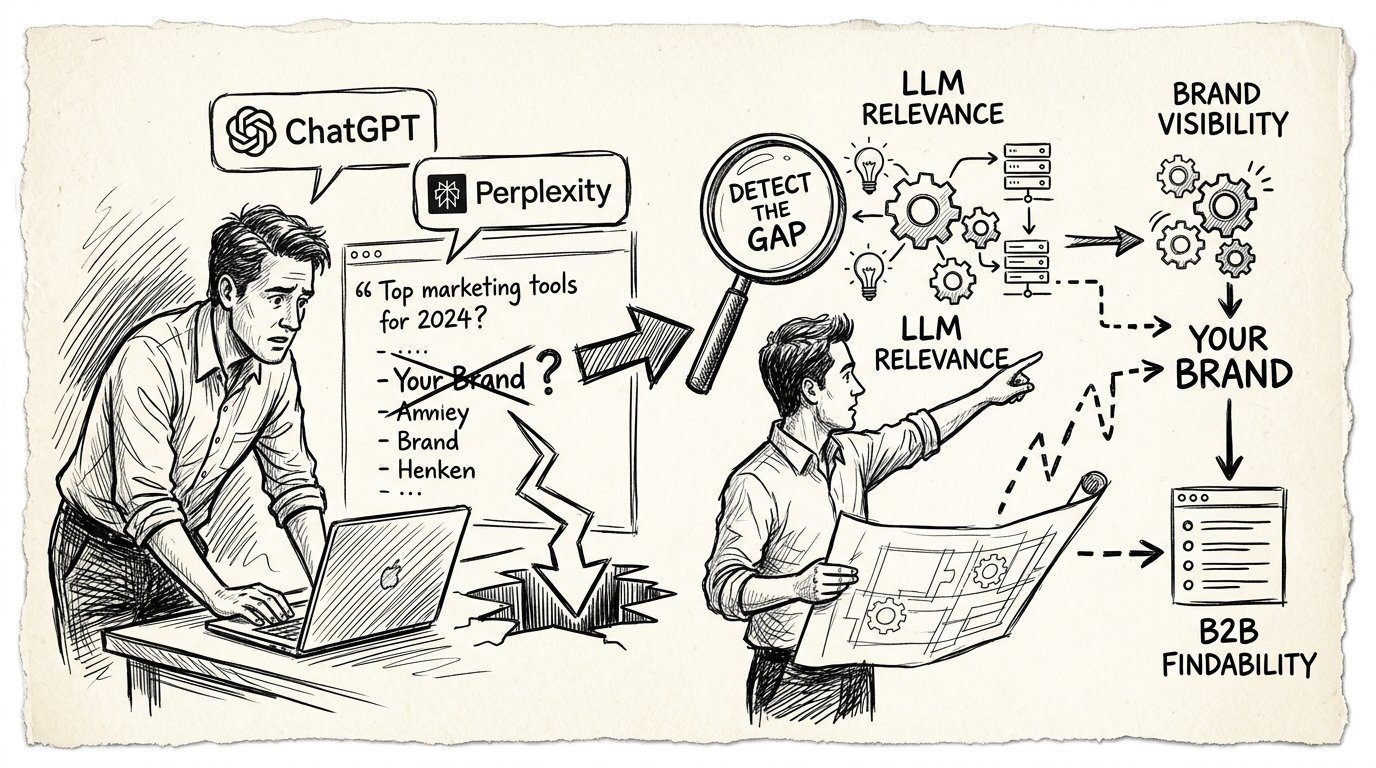
If a buyer asks ChatGPT which tools to consider in your category and your brand isn’t named, you lost that opportunity — and unlike a dropped Google ranking, nothing in your current analytics will tell you it happened.
That invisible gap is the core problem. AI search engines — ChatGPT, Perplexity, and Gemini — are now a meaningful part of the B2B discovery process. Gemini referral traffic grew 388% year over year from September to November 2025, and ChatGPT referrals rose 52% over the same period, according to Similarweb data reported by Digiday. Visitors arriving via AI tools also convert at higher rates than those from search or social. The brands being named in those answers are capturing that pipeline. The brands that aren’t have no way to know what they’re missing — unless they’re actively monitoring.
What AI Search Visibility Actually Means
“AI search visibility” is not a single score. It breaks into three distinct, measurable signals that lean marketing teams need to track separately.
Citation rate
Citation rate is how often your domain appears as a named source in AI-generated answers across your target questions. Perplexity, in particular, surfaces inline citations pointing to specific URLs, making this the most concrete metric to track. A citation means the AI system used your content to build its answer — stronger than a passing mention.
Mention rate
Mention rate measures how often your brand name appears in the answer text, regardless of whether a source URL is linked back to you. A brand can be mentioned in an answer assembled entirely from a competitor’s content, a third-party review site, or a news article. Mention rate and citation rate together give you a full picture; collapsing them into one number hides which kind of visibility you actually have.
Source share
Source share is the fraction of citations your domain holds versus competitors across a fixed set of category questions. If rivals account for 70% of cited sources when buyers ask about your problem space, that’s a gap with a concrete size — and a target you can work toward shrinking.
Tracking these three metrics as percentages over a stable question set turns “are we visible in AI search?” from a vague anxiety into a number you can move.
How AI answers are built — and why they differ by engine
ChatGPT, Perplexity, and Gemini retrieve and weight sources differently enough to behave like separate discovery channels. Perplexity retrieves live web results and cites them explicitly, making it the most auditable. ChatGPT draws on training data plus web browsing and tends to favor brands with broad, established presence across the web. Gemini is wired into Google’s ecosystem, so traditional search strength and structured data carry significant weight. The practical consequence: a page that earns a citation in Perplexity can be invisible in ChatGPT, and vice versa. Treating all three as interchangeable produces misleading conclusions.
Why Manual Spot-Checks Fall Short
The standard advice is to open each AI tool, type in some category questions, and see whether your brand appears. That’s the right starting point — but a poor measurement system.
AI answers are non-deterministic. The same prompt can surface different brands in different sessions, and absence from one answer is not evidence of consistent invisibility. A single manual check is a snapshot with no baseline, no trend, and no signal for when things change.
For a lean startup or a small marketing team, manual checking has two additional problems: time and consistency. Running 20–50 structured prompts across three engines, logging citation URLs, competitor appearances, and accuracy — then repeating that on a reliable schedule — is a meaningful operational task. Most teams run one check after launch, then never again. That means they have no visibility data when a competitor starts dominating answers, when a model update shifts citation patterns, or when previously cited content goes stale.
The content gap that existing guides overlook is this: monitoring is only useful when it’s recurring. A one-time audit tells you where you stood on one day. A monthly cadence tells you whether your visibility is growing or eroding, and which content changes are actually moving the needle.
What to do when citations dip
Monitoring without an action loop is just anxiety. When citation or mention rates drop, the diagnosis usually falls into three categories:
- Inconsistency: the information about your brand across the web contradicts itself — different descriptions on different sites — so AI systems get conflicting signals and either omit you or cite you inaccurately.
- Thinness: accurate but sparse coverage gives AI systems too little to work with. Competitors with more content, more third-party mentions, and more structured data fill the answer instead.
- Structural problems: strong reputations buried inside JavaScript-rendered pages, vague copy, or content that never directly answers a buyer’s question are invisible to AI crawlers regardless of underlying quality.
The fixes map directly to content strategy: publish answer-shaped content that directly addresses category questions, earn authoritative third-party mentions, keep key pages fresh and server-rendered, and verify that crawlers for each engine aren’t blocked in your robots.txt.
Closing the Monitoring Gap Without Adding Headcount
For a lean team, the practical challenge isn’t knowing what to monitor — it’s doing it consistently without assigning a person to run manual checks every month.
This is where scheduled AI visibility monitoring fits into a broader multi-channel marketing workflow. Rather than treating it as a standalone task, it becomes one agent job in a recurring weekly and monthly cadence alongside content, SEO, social, and paid media. mktcrew’s AI Visibility Monitor agent queries AI search engines monthly to check whether your brand is mentioned in answers to category questions — no manual effort, no dedicated analyst.
The output plugs into the same reporting layer where SEO, social, and ads data already surface. Instead of AI visibility being a separate project that gets deprioritized, it becomes a regular metric card in your weekly review — the same place you’d spot a dip in organic traffic or a drop in social reach.
That integration matters because AI visibility and content strategy aren’t separate levers. The content your Writer agent produces each week — long-form articles with verified citations, structured headings, and direct answers to buyer questions — is precisely the kind of content AI systems cite. A lean team that runs content and AI visibility monitoring together, using the same brand profile to steer both, builds compounding coverage: more authoritative pages mean more citations, which mean more brand mentions, which surface in the monthly report as evidence of what’s working.
The Shift Worth Making Now
AI search brand visibility is still an emerging discipline, and most lean teams haven’t built a monitoring habit yet. That’s both a problem and an opportunity. The brands that establish a recurring measurement baseline now — citation rate, mention rate, source share — will have actionable trend data when AI search becomes a larger share of buyer discovery. The brands that wait will be playing catch-up without a baseline to measure from.
Manual spot-checks are a reasonable first step. A recurring, automated monitoring cadence is how you turn that first check into an ongoing competitive signal — without hiring another person to maintain it.