August 24, 2026
First Marketing Hire or AI Marketing Agents? How Founders Should Make the Call
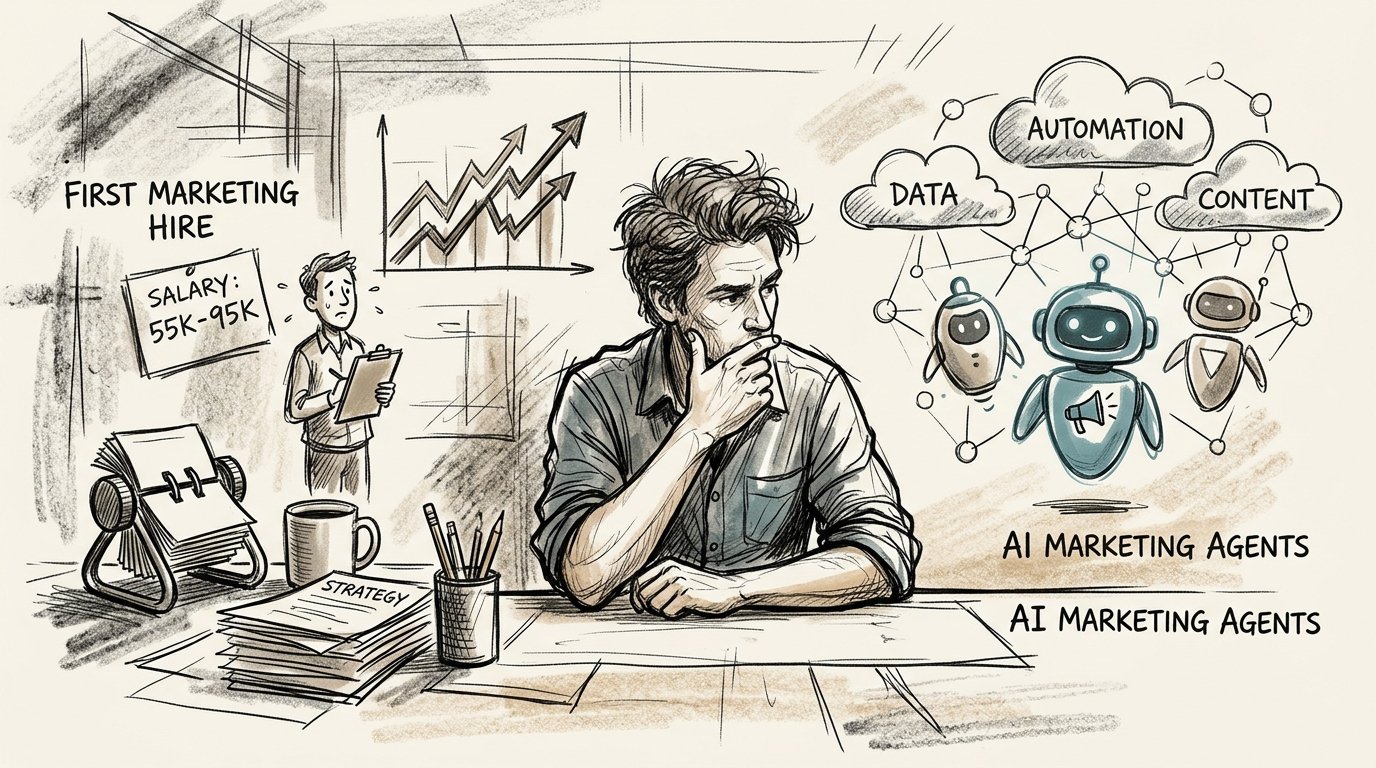
If you’re a founder staring at a $55K–$95K salary line item and wondering whether an AI marketing agent crew could do the job instead, the answer depends on which of three specific blockers is actually stalling your growth — not on the technology itself.
Most of the advice on this topic frames it as a binary: hire someone or don’t. That framing skips the diagnosis. Before the cost comparison matters, you need to know whether your marketing problem is a capacity problem, a capability problem, or a coordination problem. Each one points to a different solution.
The Three-Blocker Diagnostic
Capacity: You know what to do — you just don’t have time to do it
Capacity problems are the most common reason founders consider their first marketing hire. The content calendar sits empty. Social posts go up sporadically. The SEO brief you wrote three months ago never became an article.
This is the blocker where an AI agent crew outperforms a hire on cost and speed. A scheduled crew of specialized agents — covering content research, writing, editing, social repurposing, and reporting — runs on a weekly cadence without onboarding, without ramp time, and without a salary commitment. AI marketing agents built for lean teams operate across channels simultaneously, which a single junior hire cannot replicate.
The cost gap is significant. A mid-level marketing manager carries a base salary of $55,000–$95,000, which loads to roughly $70,000–$130,000+ annually once you factor in benefits, tools, and overhead (aimar.chat, 2026). An AI agent subscription operates at a fraction of that figure. For founders at early-revenue stage, the math strongly favors agents for capacity problems.
Capability: You’re not sure what to do next
Capability problems look like capacity problems but require a different fix. Output is inconsistent not because you lack time, but because you lack conviction about positioning, channel selection, or messaging.
Here, a hire can add value — but only if you find the right profile. As Signal Fire’s research on first startup marketing hires notes, founders who reach for a growth marketer before locking down positioning tend to burn budget on campaigns with no strategic foundation. The hire who actually moves the needle at this stage is a product marketer who can interview customers, synthesize what they hear, and define what your company should lead with.
AI agents are not a substitute for that work. They execute a strategy effectively; they do not develop one from scratch. If you cannot write a single-sentence positioning statement that your last three customers would recognize, solve that problem before deploying an agent crew or making a hire.
Coordination: You have output — it just doesn’t connect
The third blocker is less obvious. Some founders produce content steadily and run paid ads on the side, but nothing compounds because the channels don’t reinforce each other. Blog posts don’t feed social. Ad copy doesn’t reflect what’s converting organically. Reports land in inboxes unread.
This is a coordination problem, and it’s where the architecture of a platform matters more than headcount. A structured agent crew that runs content, social repurposing, ad recommendations, and reporting inside a single system — with a shared brand profile steering every agent — creates the connective tissue that a generalist hire rarely provides on their own.
The Cost and Output Comparison
Once you’ve identified your blocker, the numbers become easier to evaluate honestly.
A full-time marketing manager at the $55K–$95K salary range is a meaningful budget commitment for most early-stage companies. Fully loaded, that hire costs $70,000–$130,000+ per year before you account for the tools budget, the ramp period (typically 60–90 days before meaningful output), and the replacement cost if the fit isn’t right — which research on early startup hires suggests happens within 18 months more often than founders expect.
What that hire produces in a week depends heavily on their skill set. A generalist covers one or two channels competently, handles the rest adequately, and learns your business during the first quarter. They cannot simultaneously own SEO research, long-form content, four social channels, paid media monitoring, competitor tracking, and weekly reporting.
An AI agent crew is built around specialization by design. Dedicated agents handle keyword research from your own Search Console data, draft and edit long-form articles with verified citations, repurpose approved content for LinkedIn, Facebook, Instagram, and X, surface paid media recommendations from synced ad accounts, and compile weekly narrative reports — all on a repeatable weekly schedule. Nothing reaches a live channel without explicit human approval, which means founders retain strategic control without becoming the bottleneck on execution.
According to the U.S. Chamber of Commerce’s 2025 Empowering Small Business report, 58% of small businesses now use AI in their operations — up from 40% in 2024. The founders who treat that shift as a cost-reduction tool miss the larger point: the real advantage is consistent, multi-channel output that a lean team could not otherwise sustain.
When a Real Hire Becomes the Right Move
AI agents are not a permanent substitute for every scenario. There are clear signals that a full-time hire becomes the better investment:
- Your positioning is validated and customers are referring you without prompting.
- Output volume from your agent plan exceeds what you need to review and approve — meaning the constraint has shifted from production to editorial judgment.
- You need someone to own relationships: with press, with partners, with a sales team that needs live enablement support.
- You’re building a marketing function that will eventually require a team, and you need a senior leader who can hire and manage that team.
The stage-gating logic matters here. An AI agent crew is the right bridge when you need consistent multi-channel execution before you have the revenue stability, defined positioning, and sufficient work volume to onboard a hire into a system that actually gives them a chance to succeed. Hiring too early — into a vacuum — is consistently cited as one of the most common and expensive mistakes at this stage. The agents run the execution layer while you validate what’s working. The hire comes in after the playbook is proven.
Making the Call
The decision framework reduces to three questions:
- What is actually blocking your marketing? Capacity, capability, or coordination — each points to a different solution.
- Is your positioning defined well enough to brief someone new? If not, neither a hire nor an agent crew will fix the upstream problem.
- Do you have the revenue stability and workflow to support a full-time person? A hire needs real work to own and enough context to make good decisions. An agent crew needs a brand profile and an approval workflow.
For most founders between $0 and $1M ARR — still defining their market, running lean on headcount, and wearing the marketing hat themselves — the agent crew solves the capacity and coordination problem at a cost and speed a first hire cannot match. When positioning is locked and growth validates the investment, the hire becomes the unlock. Those are two different phases, and treating them as the same decision is where the expensive mistakes happen.
mktcrew’s AI marketing crew covers content, SEO, social, paid media recommendations, and reporting on a weekly schedule — with human approval before anything goes live. See how it compares to other alternatives, or start a 15-day free trial with no credit card required.