August 20, 2026
Fractional CMO vs. AI Marketing Agents: Which Is Right for a Startup With No Marketing Team?
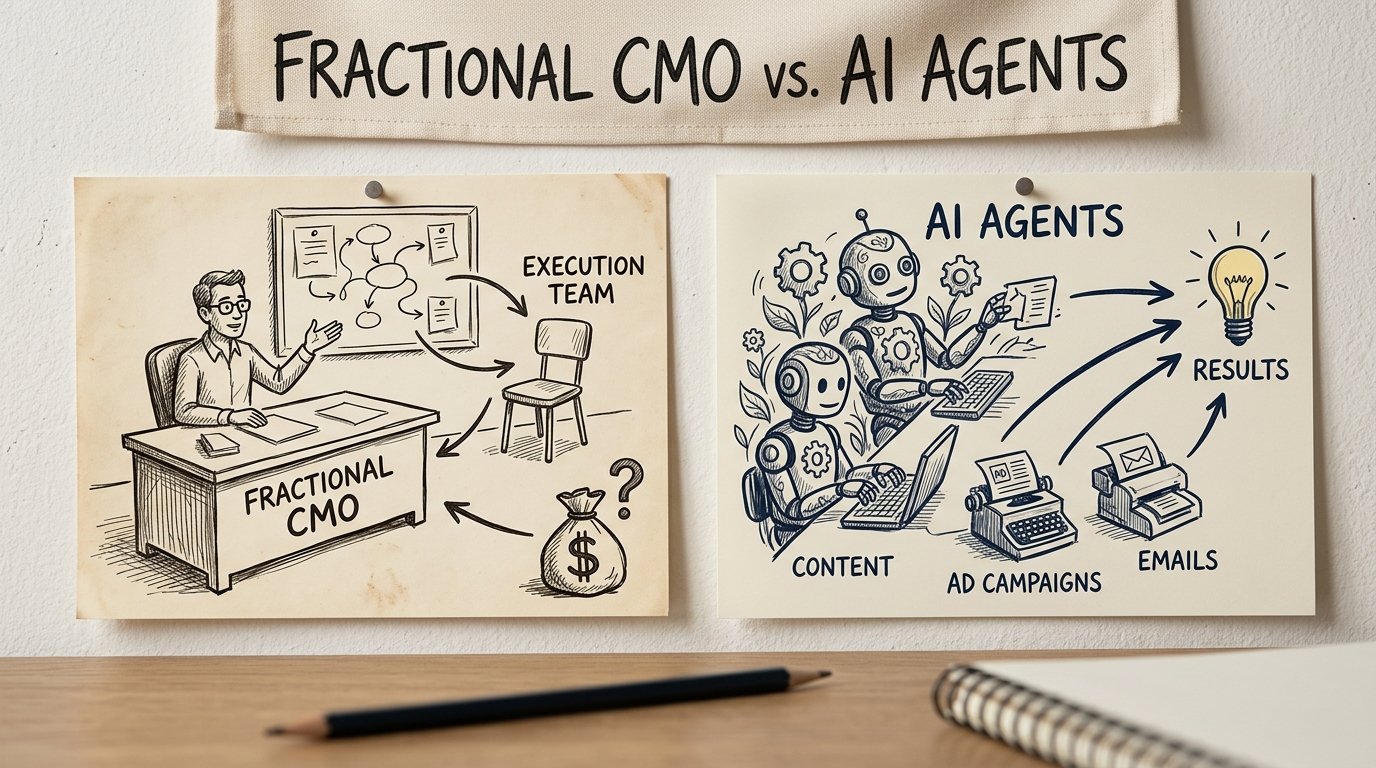
A fractional CMO gives a startup senior marketing direction on a part-time basis — but the strategy they produce still needs a team to execute it. If your startup has no marketing team, a fractional CMO hands you a plan with nobody to run it.
That execution gap is the detail most comparisons skip. Before you decide, it helps to see exactly what each option delivers, what it costs, and where each one breaks down for a lean startup.
What a Fractional CMO Actually Delivers
A fractional CMO is an experienced marketing executive available part-time, typically 10–20 hours per week, to set strategy, prioritize channels, and oversee whoever does the work. Monthly retainers run $5,000–$15,000 depending on scope and seniority (Okara.ai, 2026). That is well below a full-time CMO, whose base salary averages $347,000 annually before equity and benefits — which is why the fractional model has grown fast: the fractional CMO market doubled from 60,000 to 120,000 professionals between 2022 and 2024, reflecting a genuine shift in how startups access marketing leadership (GrowTal, 2026).
The value is real — when the conditions are right.
What a Fractional CMO Does Not Do
The job description is strategic, not executional. A fractional CMO decides which channels matter, refines your positioning, and guides the people doing the work. They do not write your content, build your email sequences, run your paid campaigns, manage your social calendar, or produce weekly performance reports. That work belongs to whoever is on your execution team.
For a startup with an existing team of writers, designers, or channel specialists, this arrangement works well. A senior strategist pointing experienced operators in the right direction is genuinely high-leverage. But for a founder who is the marketing team, or a startup that has no one in that seat, the fractional CMO produces a roadmap that sits unactioned. You are paying senior rates for a deliverable you cannot use.
Add the execution layer separately — a content writer ($3,000–$6,000/month), an SEO specialist ($2,000–$5,000/month), and a social media manager ($3,000–$4,500/month) — and what started as a fractional arrangement quickly becomes a $13,000–$25,000/month operation before tools or ad spend (getaitopia.io, 2026). Most startups do not run that math before they sign.
The Execution Gap AI Marketing Agents Fill
AI marketing agents are purpose-built for the recurring operational work that a fractional CMO delegates but does not perform. For a lean startup or a founder wearing the marketing hat, that distinction matters more than cost alone.
A platform like mktcrew deploys 20 specialized agents covering every major channel on a weekly schedule — not a one-time strategy deck, but continuous delivery:
- Content and SEO: Scout researches topics from Search Console data, Writer produces long-form drafts with verified citations, Editor scores drafts against your brand rubric, and Publisher pushes approved articles to WordPress or Webflow as drafts.
- Social media: Repurposer turns approved articles into channel-specific posts for LinkedIn, Facebook, Instagram, and X. Newsjacker drafts posts from trending news. Social Scheduler publishes on the approved calendar.
- Paid media advice: Google Ads, Meta Ads, and LinkedIn Ads optimizer agents sync daily and surface evidence-backed recommendations — without touching live campaigns.
- Competitive and AI-search intelligence: Competitor Monitor tracks rivals weekly. AI Visibility Monitor checks monthly whether AI search engines mention your brand.
- Reporting: SEO Agent and Reporter compile weekly narrative reports with executive summaries drawn from GA4, Search Console, social, and ad accounts.
Everything produced lands as a draft. Nothing posts, publishes, or changes ad settings without explicit human approval. That human-in-the-loop layer is not optional — it is how the platform is built.
Strategy Is Still Required — But It Comes Earlier
A common objection is that AI agents cannot replace the strategic layer a fractional CMO provides. That is largely correct. What changes is when and how that strategy gets set.
mktcrew builds a brand profile from your site URL within minutes of sign-up — capturing positioning, voice, target audience, competitors, and channel priorities. That profile steers every agent. It is not a substitute for a CMO’s judgment on a complex go-to-market pivot, but it is more than enough to direct consistent multi-channel execution for a startup that knows its product and customer. For many lean teams, that is the only strategic input they need to get moving.
The Honest Decision: When Each Option Wins
The right choice depends on a single question: do you need a plan, or the plan and the hands to run it?
A fractional CMO is the right call when:
– You already have a capable execution team — in-house marketers, reliable freelancers, or a retained agency — and what is missing is senior direction.
– Your primary gap is strategic judgment: positioning, messaging architecture, channel prioritization, or board-level narrative.
– You are at roughly $1M–$10M ARR, large enough to need real marketing leadership but not ready for a full-time CMO hire.
AI marketing agents are the right fit when:
– You have no marketing team and need consistent output across content, SEO, social, and reporting right now.
– Your budget does not stretch to $5,000–$15,000/month for strategy alone, let alone a separate execution layer on top.
– You want to move within days, not weeks — mktcrew delivers first article drafts to your CMS by Day 3 of a 15-day free trial, with the first SEO and analytics report by Day 7.
– You need accountability and observability: run history shows exactly when each agent executed and whether it succeeded.
The two options are not always mutually exclusive. A fractional CMO setting quarterly direction and a recurring AI agent crew handling weekly execution is a coherent setup. You get the senior strategic brain without needing to staff a separate execution layer underneath it.
What This Looks Like in Practice
A common founder pattern: hire a fractional CMO for the first 60–90 days to nail positioning, identify the two or three channels worth prioritizing, and establish a content rubric. Then hand off recurring execution — the weekly articles, social repurposing, SEO reporting, ad recommendations, and competitive monitoring — to an AI agent crew running on that foundation.
That sequence costs a fraction of maintaining both a fractional CMO and a dedicated execution team indefinitely. It also means the strategy actually gets built, not filed.
For startups where even part-time strategic help is not needed — teams that already have conviction on positioning and simply need consistent, multi-channel output — an AI marketing crew covers the full operational scope at subscription pricing, with no agency retainer, no per-channel vendor stacking, and no publishing without your approval.
The fractional CMO model is a genuine innovation for accessing senior marketing expertise. Its structural limit is that expertise without execution is still just advice. If your startup’s gap is the doing, not the planning, that is the gap to solve first.