August 3, 2026
How to Automate Your Entire Marketing Function Using AI Without Losing Human Control
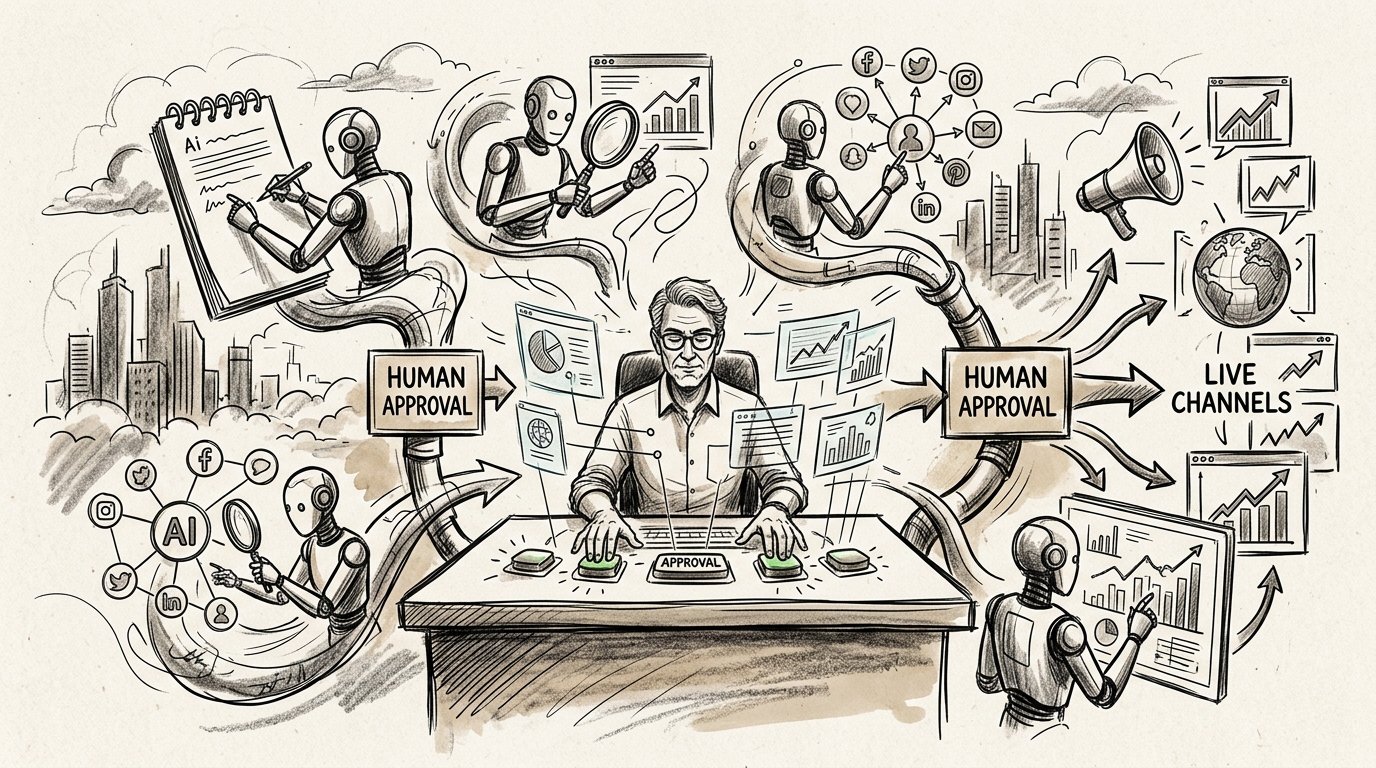
You can automate your entire marketing function using AI by assigning specialized agents to every repeatable task — content, SEO, social, paid-media recommendations, and reporting — and routing every output through a human approval step before anything reaches a live channel. The agents handle the operational work; your team retains final say over what goes out.
Why the “control vs. automation” tension is real — and fixable
Most marketing teams that hesitate to adopt AI automation are worried about one thing: losing the brand oversight they’ve spent years building. That concern is legitimate. But it points to an architecture problem, not a fundamental limit of AI.
Traditional marketing automation is rule-based. It fires predefined workflows — “if user downloads an ebook, send a nurture email” — with no learning and no judgment. AI marketing automation is different. It analyzes data, adapts to performance signals, and generates outputs like article drafts, social post variations, and ad recommendations. The gap between “generated” and “live” is exactly where human control lives.
According to McKinsey, generative AI could increase the productivity of the marketing function by 5–15% of total marketing spend. Yet the teams capturing that gain aren’t removing humans — they’re redirecting human effort from production tasks to review and decision-making. The agents produce; the people approve.
The practical design principle: automation handles volume and cadence; humans own every publishing, posting, and spend decision. Nothing should reach a customer without an explicit approval step in between.
The five layers of a fully automated — and fully controlled — marketing function
A complete AI marketing agent workflow covers five operational areas. Each one can run on a defined schedule while preserving your team’s authority at the output stage.
Content and SEO
An AI content pipeline typically runs on a weekly cadence:
- A research agent pulls Search Console data, identifies keyword gaps, and builds a topic brief with verified source URLs.
- A writer agent produces a long-form draft matched to your brand voice, with citations verified against actual source pages before being linked.
- An editor agent scores the draft against a brand rubric — tone, claims accuracy, structure — and returns specific revision notes.
- A publisher agent queues the approved article as a draft in your CMS (WordPress or Webflow), where a human completes the final publish step.
The entire sequence generates a reviewed, CMS-ready article without anyone doing the blank-page work — but no article is pushed live without your explicit action.
Social media
Social agents repurpose published articles into channel-specific post drafts for LinkedIn, Facebook, Instagram, and X. Separate agents monitor trending news and flag engagement opportunities. Scheduled posts land on a calendar for review; nothing is published until approved. This means a single approved article can become four to six social drafts without any additional writing time from your team.
Paid media recommendations
AI agents can sync daily with Google Ads, Meta Ads, and LinkedIn Ads to surface evidence-backed bid, copy, and targeting recommendations. The critical distinction: these agents analyze and recommend — they never modify live campaigns, adjust bids, or reallocate budgets. Your team reviews the recommendation, evaluates it against business context, and acts. According to Salesforce’s State of Marketing report, 63% of marketers are currently using generative AI, yet the most trust is built when AI surfaces insights and humans make the final call.
Competitive and AI-search intelligence
Competitor monitoring agents track rival content and positioning weekly. AI visibility monitors check monthly whether AI search engines (ChatGPT, Perplexity, Gemini) mention your brand in relevant answers. These monitoring agents run automatically — because they observe and report, they don’t mutate live channels — and feed their findings directly into your weekly workflow.
Reporting
Weekly reporting agents compile GA4, Search Console, social, and paid-media data into a narrative digest with executive summaries and metric cards. Instead of assembling spreadsheets on Friday afternoon, your team reads a structured report and focuses on the decisions it surfaces. This is one of the clearest examples of AI automation that requires zero human approval overhead — reports inform decisions, they don’t make them.
Building the control layer: what “human-in-the-loop” actually means in practice
“Human-in-the-loop” is not a vague reassurance — it’s a specific workflow design. Here’s what it looks like in a functional AI marketing setup:
- Draft-first architecture. Every content output — articles, social posts, ad recommendations — lands as a reviewable draft, not as a live action. Your team edits, approves, or rejects before anything moves forward.
- Defined agent scope. Each agent has a named function and a documented scope. A writer agent writes; it doesn’t publish. A publisher agent pushes to CMS as a draft; it doesn’t click “publish.” Scope limits prevent any single agent from completing a full publish cycle without human intervention.
- Run history and observability. Knowing when agents ran, what they produced, and whether they succeeded gives you the audit trail needed to catch errors early and maintain brand accountability.
- OAuth-only integrations. Platform passwords should never be stored by an automation layer. OAuth tokens give agents the access they need while keeping credentials in your hands and revocable at any time.
- Role-based access. Owners, admins, and editors have differentiated permissions. Not everyone on the team needs to approve every output type — but every output type needs someone authorized to approve it.
The SurveyMonkey AI in Marketing study found that 43% of marketing professionals already automate repetitive tasks with AI, and 88% use AI tools in their day-to-day roles. The gap between “experimenting” and “fully automated” almost always comes down to whether teams have designed a clear approval layer — not whether the technology can do the work.
How to get started without disrupting what’s working
You don’t need to automate everything at once. The highest-leverage starting point for most lean teams is the content and SEO pipeline: it’s the most time-intensive recurring job, the output is easy to review before it goes live, and the compounding value (search traffic, social repurposing material) is high.
From there, layer in reporting automation — it removes manual assembly without any approval overhead. Then add social repurposing to extend the reach of content you’ve already approved. Paid media recommendations and competitive intelligence can follow once the core content loop is running.
If you’re a small team or a founder running marketing solo, platforms like mktcrew are designed specifically for this model: 20 specialized agents covering content, SEO, social, paid-media recommendations, and reporting — all running on a weekly schedule, with human approval required before anything reaches a live channel. The mktcrew agent crew connects via OAuth to the tools you already use (WordPress, Webflow, GA4, Search Console, Google Ads, Meta Ads, LinkedIn, and more) and generates a brand profile from your site URL within minutes of sign-up.
Automating marketing without sacrificing control is a design choice
The real question isn’t whether AI can handle your marketing function — it’s whether your workflow is designed to keep humans in the right seat. Agents that research, draft, score, repurpose, and report are genuinely powerful. But the value of that power is only stable when every output routes through a review step before it reaches a customer.
Build the approval layer first. Then let the agents fill in the work around it. That’s the model that scales without the brand risk.