August 1, 2026
Human-in-the-Loop AI Marketing: Why Approval-First Beats Set-and-Forget
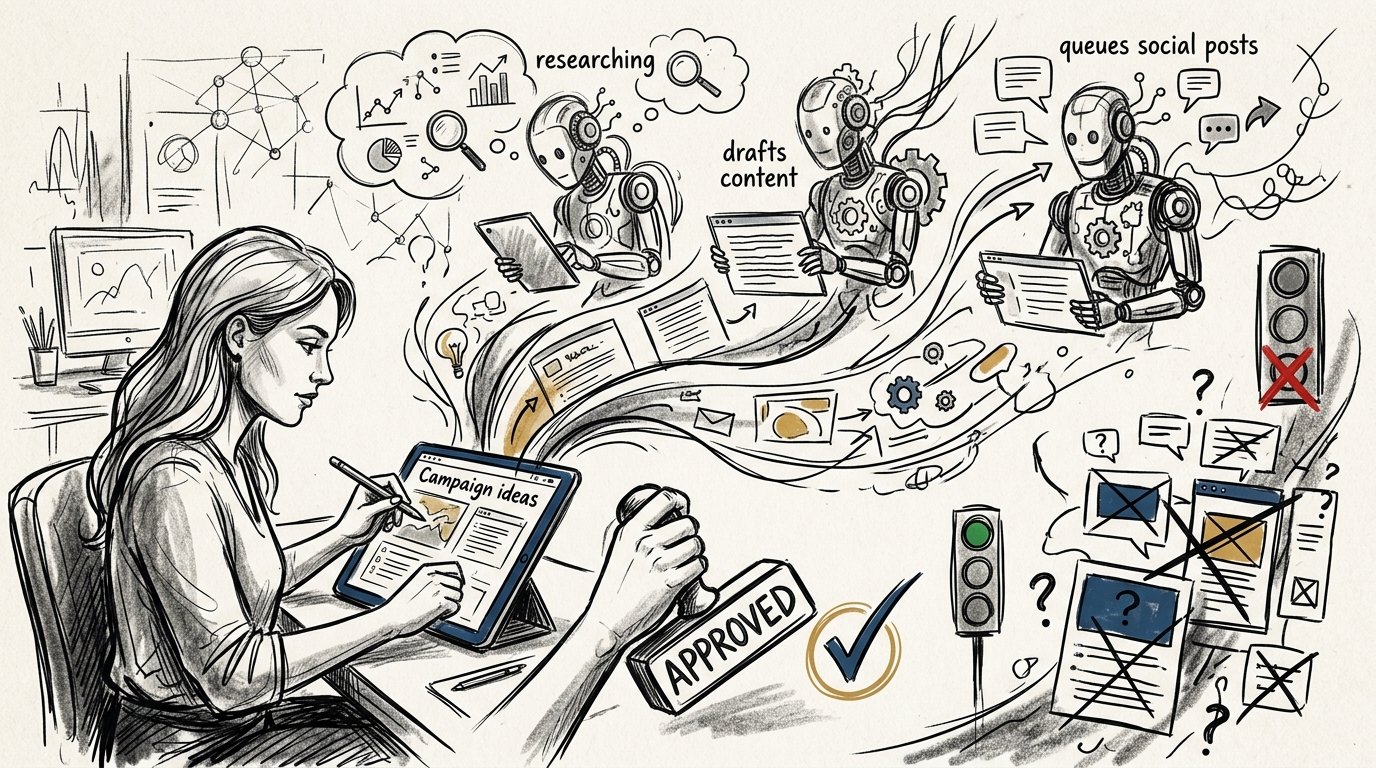
Human-in-the-loop (HITL) AI marketing means AI agents do the recurring operational work — researching topics, drafting content, queuing social posts, surfacing ad recommendations — while a human reviews and approves every output before it reaches a live channel. That distinction separates teams that get results from teams that quietly damage their brand.
Why Set-and-Forget Marketing Automation Fails
Fully automated marketing pipelines sound efficient until the first error goes public. AI systems, even strong ones, operate on probability and pattern matching. They do not know that your company just pivoted its positioning, that a competitor quietly lowered its prices, or that a statistic your draft is citing has since been revised.
The consequences of publishing without review are concrete:
- Hallucinated facts. Generative AI can produce incorrect statistics, fabricated citations, and outdated regulatory claims — all written in a confident, authoritative tone. If no human checks the draft, those errors reach your audience intact.
- Brand voice drift. Without consistent editorial oversight, AI-generated content gradually becomes generic. Customers begin to notice, and the distinctiveness your brand built over time erodes. Millions of businesses are now prompting the same AI models with nearly identical instructions and getting nearly identical output (adWhite Marketing, 2026).
- Compounded mistakes at scale. Automation without oversight does not contain errors — it multiplies them. A wrong claim published automatically to your blog, repurposed into three social posts, and included in a weekly email is not one mistake; it is a cascade.
The broader market is arriving at this conclusion. About 70% of workplace AI users report that AI is reliable only when paired with human review or oversight (Improvado, 2026). That consensus is not skepticism toward AI — it is a recognition that AI speed and human judgment are complements, not substitutes.
What Human-in-the-Loop Actually Means in a Marketing Workflow
HITL is not a single feature or checkbox. It is a design principle: AI handles repetitive, high-volume execution, and humans retain decision authority at the points where a wrong call has real consequences.
In a practical marketing workflow, that looks like this:
The Agent Does the Work
Specialized agents research topics from your search data, write long-form drafts with verified citations, score drafts against a brand rubric, repurpose published articles into channel-specific social posts, and surface paid media recommendations from synced campaign data. Each step runs on a defined schedule.
The Human Holds the Gate
Nothing publishes, posts, or changes until a person clicks approve. Articles land in WordPress or Webflow as drafts. Social posts wait on a review calendar. Ad recommendations surface as evidence-backed suggestions — the agent never touches a live campaign. Every action that could reach a live channel requires an explicit human decision.
This mirrors what Zapier’s research on agentic workflows describes as the approval flow pattern: the system pauses at a pre-determined checkpoint, a human reviews or edits the output, and only then does the workflow continue (Zapier, 2025). The distinction from full automation is not just philosophical — it is functional. Approval gates catch errors before they compound, preserve brand accountability, and build the kind of trust that makes teams willing to delegate more to AI over time.
Why the Feedback Loop Matters
Every approval or rejection teaches the system what good looks like for your brand. An agent that receives consistent feedback on tone, accuracy, and style produces better drafts each cycle. The intervention rate drops as the agent learns, but the human always retains veto power. Better human feedback leads to better model outputs, and better model outputs require less intervention — the loop compounds in both directions (Databricks, 2025).
Building an Approval-First AI Marketing System
For small marketing teams and founders running marketing themselves, the practical question is not whether to use AI — 58% of small businesses already use generative AI tools, up from 40% in 2024 (U.S. Chamber of Commerce via Capsule CRM, 2025). The question is how to capture the efficiency gains without surrendering control.
A few principles that distinguish approval-first systems from set-and-forget ones:
- Define clear approval gates before agents run. Decide upfront which actions require human sign-off — publishing an article, scheduling a social post, changing an ad recommendation — and treat those gates as non-negotiable.
- Separate recommendation from execution. Ad optimization agents should surface evidence-backed recommendations, not execute bid or budget changes. The human decides what to apply and when.
- Route brand-sensitive outputs to a named reviewer. Content that carries your brand voice or makes product claims should always pass through someone who can assess context, not just grammar.
- Use OAuth-only integrations so platform credentials stay secure. If an AI system requires storing your ad platform passwords, the security risk is an argument against using it at all.
- Preserve a final CMS publishing step. Even when an agent pushes an approved article to WordPress or Webflow as a draft, the final publish decision should remain with the content owner.
mktcrew’s 20 specialized AI agents are built around this model: agents handle the recurring operational work across content, SEO, social, paid media intelligence, and reporting, while every live action — publish, post, schedule, ad change — requires explicit human approval. Nothing goes live on autopilot.
Approval-First Is a Competitive Advantage, Not a Constraint
Teams that build human oversight into their AI marketing workflows tend to move faster over time, not slower. The upfront investment in clear approval gates, defined brand rubrics, and consistent feedback eliminates the expensive rework — corrections to published errors, reputation repair, ad spend wasted on unapproved copy — that fully automated systems eventually generate.
For lean teams already stretched thin, that reliability is the point. An AI marketing crew that surfaces reliable drafts every week, routes them for your review, and only acts on your explicit approval is not a slower version of automation. It is what makes automation trustworthy enough to depend on.
The set-and-forget model assumes the AI will always get it right. The approval-first model assumes the AI will mostly get it right — and puts you in position to catch the exceptions before they matter.