August 15, 2026
How Lean Startups Handle Marketing Operations Without a Marketing Ops Hire
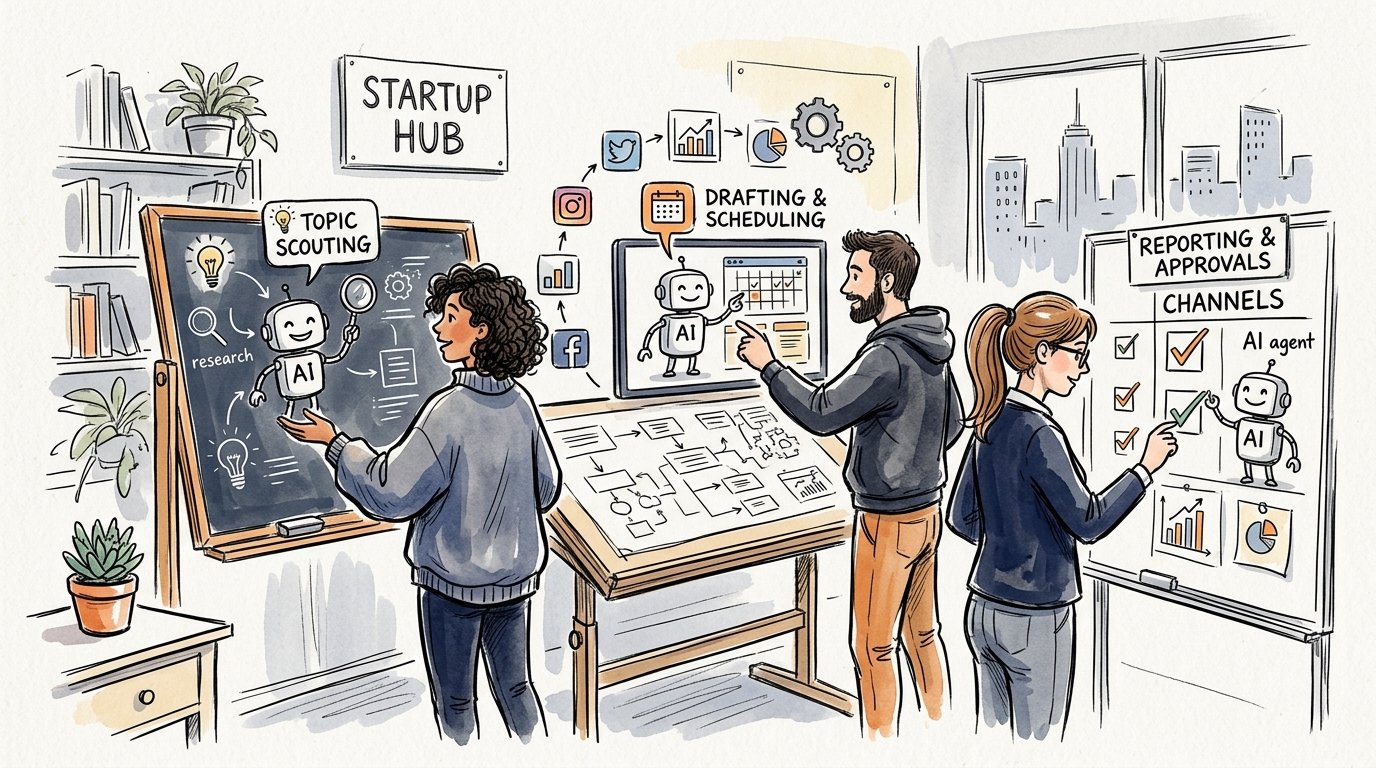
Lean startups can run disciplined marketing operations without a dedicated marketing ops hire by using a scheduled crew of AI agents to handle the recurring weekly work — topic scouting, drafting, scheduling, channel approvals, and reporting — that normally requires a full-time specialist to coordinate.
What “Marketing Operations” Actually Means at a Company of 1–5 People
Enterprise content on marketing operations assumes a HubSpot or Marketo stack, a dedicated MOps manager, and a team of junior executors beneath them. None of that maps to a startup where the founder, a growth hire, or a solo marketer is doing every role at once.
At a company of 1–5 people, marketing operations is not a department — it is a set of recurring tasks that either get done consistently or get skipped under pressure. Those tasks break into five weekly loops:
- Topic and keyword scouting — identifying what to create based on actual search demand and site performance data
- Content drafting and editing — producing articles, social posts, or ad copy against a brand voice and quality bar
- Channel approval and scheduling — reviewing output before it reaches any live platform and queuing it on a publishing calendar
- Performance reporting — pulling data from GA4, Search Console, and ad accounts into a readable summary
- Competitive monitoring — checking whether rival positioning or messaging has shifted
When even one of these loops breaks down — which happens whenever the founder or sole marketer gets pulled into a product sprint, a funding round, or a customer escalation — the entire output cadence collapses. An article queue goes dark. Social channels fall silent. Reports stop arriving. The inconsistency is not a motivation problem; it is an infrastructure problem.
The Cost of Missing MOps Infrastructure
Marketing operations is facing a documented talent crisis: MOps teams are top-heavy, junior talent is scarce, and senior professionals are pulled back into execution instead of strategy. For startups that cannot staff a dedicated ops role at all, the problem is more fundamental — there is no one to own the recurring cadence.
Employees who adopt automation tools save a median of 3.6 hours per week compared to purely manual workflows, equivalent to 23 working days a year (Salesforce / Slack State of Work Report). For a solo marketer, that recovered time is the difference between shipping a content quarter and missing it entirely.
The Weekly Cadence a Lean Team Actually Needs
The solution is not to compress a full MOps function into a checklist — it is to design a minimal but complete weekly rhythm that runs whether or not anyone is paying close attention to it.
A workable weekly MOps cadence for a lean startup looks like this:
- Monday — a topic scout reviews search performance data and queues 1–2 article briefs based on keyword gaps and Search Console signals
- Tuesday–Wednesday — a writer drafts each article with verified citations; an editor scores it against a brand rubric before it reaches human review
- Thursday — approved articles are pushed to the CMS as drafts; a social repurposer turns each article into channel-specific posts for LinkedIn, Instagram, Facebook, and X
- Friday — a reporter compiles the week’s performance across GA4, Search Console, and ad accounts into a narrative summary with metric cards; a competitor monitor checks rival messaging for changes
Every step in this sequence produces a deliverable for human review before anything goes live. That approval step is not optional overhead — it is the accountability layer that keeps a lean team in control of its own brand, even when the execution is automated.
Where Human Approval Fits In
The gap in most discussions of marketing automation versus marketing operations is the approval workflow. Marketing automation tools send emails, post to social, and trigger sequences — often without a human seeing the output first. Marketing operations at a mature company adds governance: brand reviews, legal sign-offs, scheduling calendars, and performance gates before campaigns run.
Lean startups need that governance layer without the headcount it normally requires. A human-in-the-loop model — where every draft, post, and recommendation surfaces for an explicit approval decision before it touches a live channel — gives a two-person team the oversight of a much larger one. Nothing publishes, posts, or spends without a deliberate click from someone who owns the output.
How an AI Agent Crew Acts as a Lightweight MOps Layer
AI agents for marketing operations now deliver a measured 6.1 hours of recovered time per week in marketing operations roles, with a 3.1x productivity multiplier on tasks completed (Bain / McKinsey Global AI Survey 2026, compiled by Digital Applied). For a founder or lean team already stretched thin, that recovery is what makes consistent marketing output possible.
A scheduled agent crew replaces the coordination overhead of a MOps hire by running each loop on a fixed cadence:
- Scout agent — queries Search Console data weekly to identify topic opportunities ranked by traffic potential and keyword gap
- Writer and Editor agents — produce and score long-form drafts against the brand profile before any human review step
- Publisher agent — pushes approved articles to WordPress or Webflow as drafts, preserving the CMS publish step for the human owner
- Repurposer agent — atomizes each article into platform-specific social posts on the approved posting schedule
- SEO and Reporter agents — compile weekly performance narratives from GA4, Search Console, social, and ad accounts with executive summaries and metric cards
- Competitor Monitor agent — tracks rival domains weekly and surfaces changes to positioning, messaging, or product pages
This is different from traditional marketing automation, which handles triggers and sequences but requires a human to build and maintain every workflow. An agent crew handles the judgment layer — deciding what to create, how to write it, and how to frame performance data — while keeping the human in the final approval seat.
For lean startup teams looking at this model, the practical entry point is a 15-day free trial that delivers first article drafts to the CMS by Day 3 and a first SEO and analytics report by Day 7 — fast enough to evaluate whether the cadence fits before making any commitment.
What This Doesn’t Replace
An AI agent crew is an execution layer, not a strategist. It runs the recurring operational work accurately and on schedule; it does not set the annual marketing strategy, run customer discovery, or make brand positioning decisions. A founder or growth lead still owns those calls. What changes is that the weekly execution — the content, the social queue, the reports, the competitor checks — runs even when that person’s attention is elsewhere.
Teams already working with a fractional CMO or a small in-house marketing team often find the agent crew most useful as the execution layer beneath strategic direction: the CMO sets the playbook; the agents run it every week without requiring manual coordination.
Running MOps Without the MOps Hire
The recurring failure mode for lean startup marketing is not a lack of ideas or intent — it is a lack of infrastructure to turn intent into consistent weekly output. Topic research gets skipped. Articles stall in draft. Reports go unread because no one compiled them. Competitor changes go unnoticed.
A scheduled AI agent crew addresses that infrastructure gap directly: it covers the five weekly MOps loops (scouting, drafting, approvals, publishing, reporting) on a fixed cadence, connects to the integrations a startup already uses via OAuth, and surfaces every output for human review before it touches a live channel. The result is a marketing operation that runs on schedule — without the hire it would otherwise require.