July 30, 2026
Newsjacking for Lean Teams: How an AI Agent Monitors Trends and Drafts Posts Before the Moment Passes
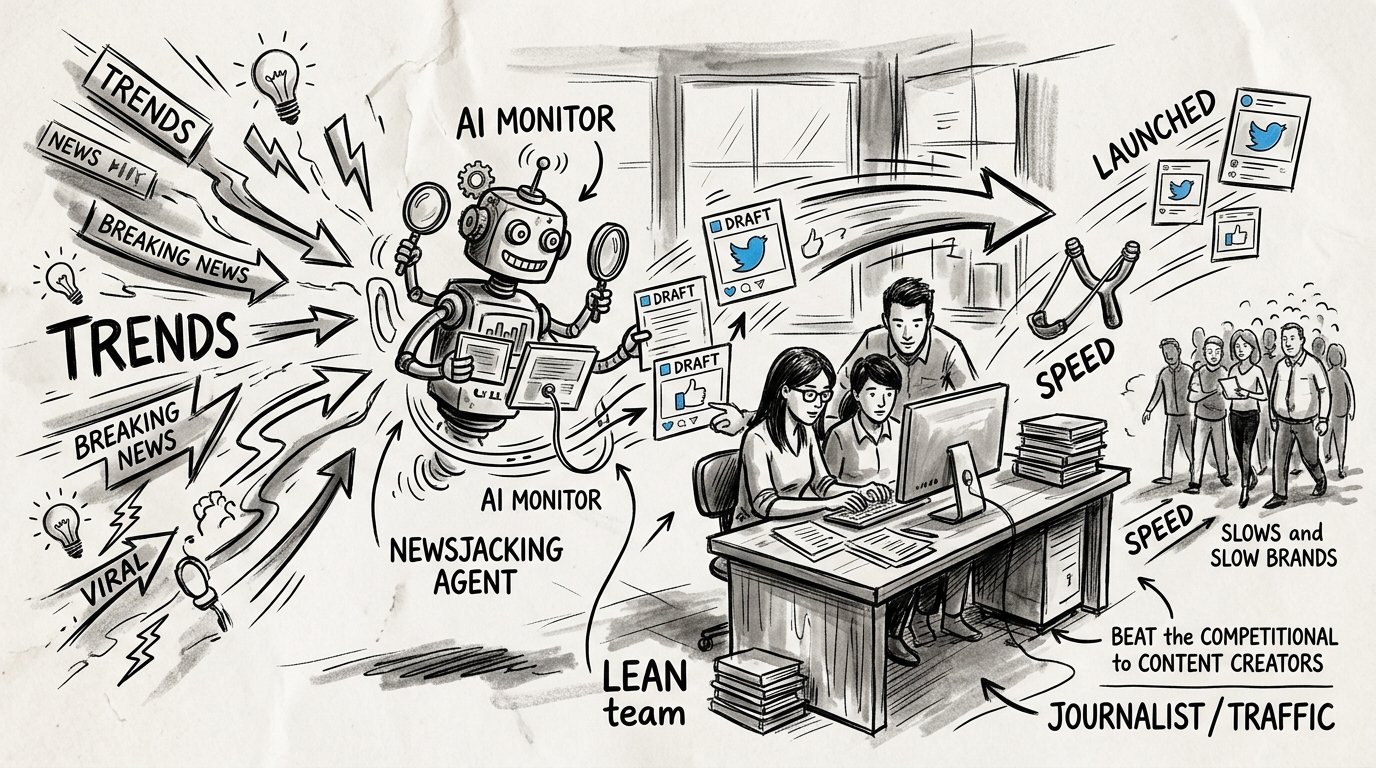
Newsjacking works when you move faster than every other brand in your niche — which makes it one of the hardest tactics for a 1–5 person team to execute consistently. The good news: an AI agent that monitors trends on a schedule and drafts on-brand social posts closes that speed gap without requiring anyone to watch the news feed all day.
Why Speed Is the Only Thing That Matters in Newsjacking
Newsjacking — a term coined by marketing strategist David Meerman Scott in his 2011 book of the same name — is the practice of inserting your brand into a breaking news story to earn attention and engagement before a topic peaks. The mechanics are straightforward. Every news story follows a bell-curve life cycle: coverage builds, hits a peak, then drops off. Your window to attach your brand to that wave sits in the rising phase, typically a one-to-three hour window before the story becomes oversaturated (Brandwatch).
Miss that window and you are commenting on yesterday’s news. The audience is already gone. Journalists have stopped looking for fresh angles. The hashtag has peaked. Rather than earning visibility, a late post reads as performative or out of touch.
For large marketing teams with a dedicated social media manager refreshing feeds, that window is manageable. For a two-person startup or a founder juggling product and sales, it almost never is. When 78% of marketers say they work in teams of one to three people (Averi, 2025), the “monitor trends all day” instruction that most newsjacking guides assume simply does not apply to the majority of marketers actually reading those guides.
The Manual Workflow Problem
A manual newsjacking process requires three things happening in near-simultaneous sequence: someone spotting the story, someone drafting a relevant post in the right brand voice, and someone approving and publishing it — all within that 1–3 hour window. Each handoff burns time.
In practice, lean teams discover a relevant story at 2 PM, draft something by 4 PM, get the approval conversation going on Slack by 5 PM, and post by 6 PM — hours after the peak engagement window closed. The post might still go out, but the earned media moment is gone. Consistency is even harder: a team might successfully newsjack once in a great week and miss every opportunity the next two.
How an AI Agent Changes the Equation
An AI Newsjacker agent changes the equation by removing the two slowest parts: monitoring and drafting.
Rather than waiting for a team member to notice a relevant trend, the agent monitors news and social signals on a scheduled cadence. When a story matches the brand’s topic filters, it drafts a post tailored for the right channel — concise on X, narrative on LinkedIn, visual-first on Instagram — drawing on the brand profile to keep voice and positioning consistent. That draft lands in a review queue automatically, ready for one approval decision from a human team member.
This is how mktcrew’s Newsjacker agent operates within the broader 20-agent crew. The draft arrives. You review it. You approve it, edit it, or reject it. Nothing goes live without that explicit human decision. The agent handles the monitoring and drafting; you make the final call on what your brand says publicly.
What Changes Operationally
The shift is concrete. Before an AI agent, a lean team’s newsjacking workflow is:
- Founder or marketer manually monitors news feeds (time variable, usually inconsistent)
- Recognizes a relevant story (often late)
- Drafts a post under time pressure (tone often suffers)
- Waits for informal approval over Slack or email (kills remaining window)
- Posts manually to each platform
After the agent takes over the first two steps:
- Agent monitors trends on schedule, fires when a relevant story surfaces
- Draft arrives in review queue, formatted for the target channel
- Human reviewer reads the draft — typically under two minutes if the brand context is embedded correctly
- Human approves, edits, or rejects
- Approved post goes to the social calendar as a scheduled draft
The monitoring and drafting time collapses. The human review step — the one that should never be skipped — stays in place.
Brand Voice at Speed
Speed without consistency destroys brand equity as fast as silence does. A rushed post that sounds nothing like the brand voice, misreads the sentiment of a news story, or drifts into controversial territory creates more damage than simply missing the moment.
The reason a well-configured AI agent can draft at speed without sacrificing voice is the brand profile: the positioning, tone, audience description, and topic filters that every agent reads before producing output. When that context is accurate and detailed, the draft that arrives in the queue already reflects how the brand talks, not a generic approximation. The reviewer’s job is a judgment call — is this the right story to comment on, and does this draft capture that moment well — rather than a full rewrite.
This is the same human-in-the-loop principle that governs every output in mktcrew’s approval workflow: agents do the research and drafting, humans control every live publish decision.
Applying Newsjacking Consistently, Not Just Occasionally
The real advantage of automating the monitoring and drafting layer isn’t the one great newsjacking win — it’s the cadence. A single successful newsjacking moment can earn outsized visibility: a small business that was quick to comment on a relevant industry story has earned significant press coverage at near-zero cost in well-documented examples going back to the tactic’s origins. But one great moment every six months, separated by long stretches of silence, doesn’t build a brand presence.
Consistent, on-brand engagement with relevant news — even with smaller stories that matter deeply to your specific audience — builds a reputation as a brand that is dialed in to its industry. That reputation compounds. Audiences begin to expect commentary from you when relevant news breaks. That expectation is earned only by showing up reliably, which is exactly what a team of one or two people cannot sustain manually.
The automation handles the monitoring rhythm so that your team isn’t only newsjacking when someone happens to be watching. Every relevant trend, on every scheduled check, gets surfaced and drafted. Your team reviews what arrives and decides what goes out.
The One-Decision Advantage for Lean Teams
The biggest operational win for lean teams isn’t the drafts themselves — it’s compressing a multi-step, multi-person workflow into a single decision.
Instead of: spot story → draft → route for approval → post across channels, the lean team sees: review draft → approve or reject.
That compression is what makes consistent newsjacking possible for a 1–5 person team. The judgment call — whether this story fits the brand, whether the draft tone is right, whether the timing still makes sense — stays with the human. The research, monitoring, and drafting that typically consume the available time window are handled before the human ever enters the process.
Newsjacking has always rewarded the brands with the fastest, best-coordinated workflows. AI agents don’t change the rules of the game — they give lean teams a workflow that can actually compete.