June 6, 2026
What Are AI Marketing Agents? How Autonomous AI Crews Are Replacing Traditional Marketing Teams
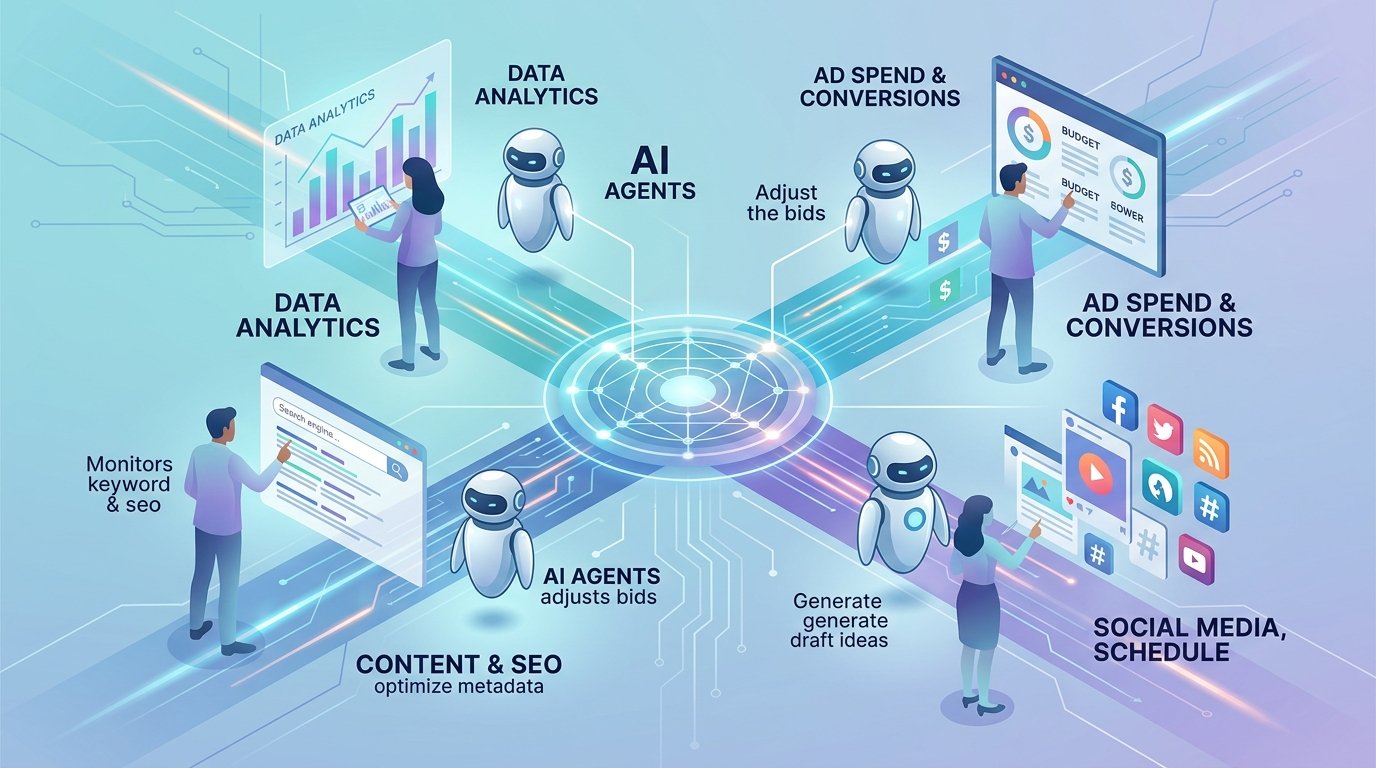
Marketing teams have always juggled multiple disciplines at once — publishing content, chasing keyword rankings, scheduling social posts, optimizing ad spend, and making sense of a mountain of analytics data. For decades, the answer was either to hire more specialists or stitch together a growing stack of single-purpose software tools. Now a third option is emerging: AI marketing agents that can take on each of those functions autonomously, working together as a coordinated crew.
This shift is more than incremental. It represents a structural change in how marketing work gets done — and understanding it is quickly becoming a prerequisite for any organization that wants to stay competitive.
What Is an AI Marketing Agent?
At its core, an AI agent is a software system capable of autonomously performing tasks on behalf of a user or another system. Unlike a traditional automation rule — which simply triggers a pre-defined action — an AI agent reasons through a goal, selects the right tools, executes a sequence of steps, and adapts based on feedback. It plans, acts, observes the result, and refines its approach.
In a marketing context, that autonomy becomes extraordinarily powerful. A marketing AI agent isn’t just scheduling a post or sending a template email. It can research a topic, draft long-form content aligned to brand guidelines, identify the most relevant keywords, choose the optimal publishing time, and report back on performance — all without a human manually directing each step.
What separates an AI agent from a conventional AI tool is this ability to chain tasks together and make judgment calls along the way. A standard AI writing assistant waits for a prompt. An AI agent reads the brief, plans the approach, writes the draft, runs an SEO check, flags any issues for human review, and queues the piece for publication — end to end.
How a Multi-Agent Crew Divides and Conquers Marketing
A single AI agent handling every marketing function would face the same bottlenecks any generalist does: depth of expertise diluted across too many domains. The more effective model is a crew — a team of specialized agents, each mastering one channel, collaborating to execute a unified marketing strategy.
Consider how this plays out across the core marketing functions:
- Content agent — Researches topics, drafts blog posts and landing page copy, maintains brand voice, and queues content for editorial review.
- SEO agent — Conducts keyword research, audits on-page optimization, monitors rankings, and surfaces content gap opportunities.
- Social media agent — Schedules posts across platforms, tailors messaging per channel, tracks engagement signals, and surfaces trending topics.
- Ads agent — Manages campaign structure, adjusts audience targeting, tests ad creative variations, and monitors budget pacing.
- Reporting agent — Aggregates data from all channels, surfaces performance summaries, and flags anomalies that need attention.
Each agent is purpose-built for its domain. When they work in concert, the output of one agent becomes the input for another. The content agent’s published article informs the SEO agent’s ranking targets; the SEO agent’s keyword data shapes the next content brief; the social agent amplifies the published piece; the reporting agent ties the whole loop back to business outcomes. This inter-agent coordination is what distinguishes a multi-agent marketing system from a collection of isolated point solutions.
Critically, this architecture scales in a way that neither a human team nor a monolithic AI tool can match easily. A startup can deploy the same crew model as an enterprise — the scope of work adjusts, but the structure stays consistent across organizations of every size.
The Human Approval Layer — Autonomy Without Losing Control
One of the most common concerns about AI-driven marketing is the loss of human judgment and brand accountability. What happens when an agent publishes something off-message? What if an ad campaign gets paused at exactly the wrong moment? These are legitimate questions, and they expose a blind spot in how most AI tools are discussed: autonomy is presented as binary — either the AI does everything, or a human does.
A well-designed AI marketing crew treats human oversight as a deliberate feature, not an afterthought. The approval layer sits between agent output and real-world execution. Drafts are written by the content agent, but a human marketer reviews and approves before anything goes live. Ad creative is assembled and tested by the ads agent, but budget changes above a defined threshold require sign-off. The SEO agent surfaces recommendations, but a human decides which ones to prioritize this quarter.
This model preserves the speed and scale benefits of AI execution while keeping human judgment exactly where it matters most — at the decision points with the greatest strategic or reputational weight. Teams don’t relinquish control; they redirect their attention from repetitive execution to higher-value decisions.
The result is a collaborative dynamic rather than a replacement dynamic. The AI crew handles the volume and velocity of marketing operations; the humans provide direction, tone, brand sensibility, and final approval. Neither works as well without the other.
Integrating an AI Crew With Your Existing Stack
A persistent concern when evaluating any new marketing platform is migration cost. Most teams have already invested in a CRM, an email platform, analytics tools, a CMS, and various ad management interfaces. The prospect of abandoning that infrastructure — and the institutional knowledge embedded in it — is a significant barrier.
The most practical AI marketing crew model doesn’t demand a full platform migration. Instead, it plugs into the integrations a team already uses. The content agent can publish directly to an existing CMS. The ads agent can connect to live campaign accounts. The reporting agent pulls from the analytics sources already in place. The crew augments the existing stack rather than replacing it.
This approach also means the agents work with real, live data from a company’s own environment — not generic benchmarks or simulated scenarios. The SEO agent tracks the actual domain’s rankings. The social agent monitors the brand’s actual engagement metrics. Over time, the crew becomes increasingly calibrated to the specific context of the business it serves.
For organizations evaluating an AI marketing platform, the right question isn’t “what do we have to give up?” — it’s “what does this connect to?” A crew model built on open integrations removes the all-or-nothing barrier and lets teams adopt at their own pace.
Conclusion
AI marketing agents represent a meaningful evolution in how marketing work gets organized and executed. The shift from single-purpose tools or siloed human teams toward a coordinated, channel-specific AI crew isn’t just a technology upgrade — it’s a new operating model. Specialized agents handling content, SEO, social, ads, and reporting in concert produce coverage and consistency that would be difficult to sustain manually at scale.
What makes this model viable for real organizations isn’t raw autonomy — it’s the combination of autonomous execution with deliberate human oversight. When those two elements work together, and when the crew connects to the tools a team already relies on, the result is a marketing operation that runs with greater speed and coverage while keeping the humans in the loop on the decisions that matter most.
Frequently Asked Questions
What is an AI agent in marketing?
An AI marketing agent is an autonomous software system that can plan, execute, and refine marketing tasks — such as writing content, managing ad campaigns, or tracking SEO performance — without requiring step-by-step human direction. Unlike basic automation, agents reason through goals, use available tools, and adapt based on results. They are designed to handle complex, multi-step workflows independently.
How do AI agents differ from traditional marketing automation tools?
Traditional automation tools execute pre-set rules: if X happens, do Y. AI agents go further by reasoning about goals, selecting the appropriate actions dynamically, and adjusting their behavior based on outcomes and feedback. A rule-based tool sends an email when a form is submitted; an AI agent can research a prospect, draft a personalized message, choose the right send time, and report on the outcome — adapting its approach as it learns.
Can AI agents replace a marketing team?
AI agents are most effective as a complement to human marketers, not a wholesale replacement. They excel at handling the volume, speed, and consistency of execution — producing content drafts, monitoring campaigns, analyzing data — while humans retain approval authority and strategic direction. The human-in-the-loop model ensures brand accountability is maintained even as the AI crew handles a significant portion of operational work.
What tasks can AI marketing agents handle autonomously?
AI marketing agents can autonomously handle a broad range of tasks, including drafting and optimizing content, conducting keyword research, scheduling and posting to social channels, managing ad audience targeting and budget pacing, and compiling performance reports across channels. The scope of autonomous execution is typically governed by approval workflows that escalate to human review for higher-stakes decisions.
What is a multi-agent marketing system?
A multi-agent marketing system is a coordinated network of specialized AI agents, each responsible for a distinct marketing function — such as content, SEO, social media, advertising, or analytics. Rather than relying on a single generalist AI, each agent develops deep capability in its domain and shares outputs with the other agents in the crew. This division of specialization enables broader coverage and tighter coordination across the full marketing mix under one connected system.