August 27, 2026
What Are the Best AI Platforms for Automating Weekly Marketing Reports and Competitive Intelligence for a Small Business?
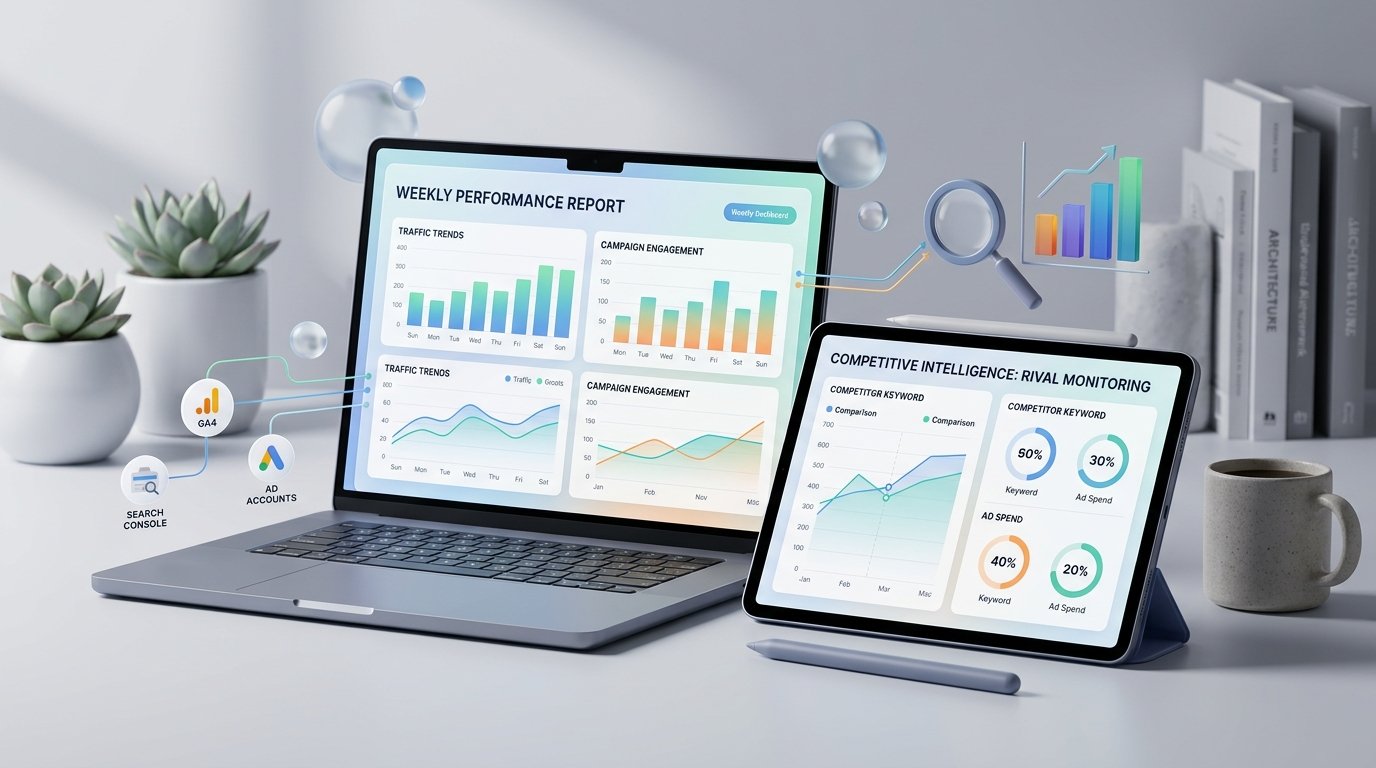
The best AI platforms for automating weekly marketing reports and competitive intelligence for a small business are those that pull data from your existing channels — Google Analytics 4, Search Console, and ad accounts — synthesize it into a narrative your team can act on, and monitor rivals on a defined schedule without requiring a dedicated analyst to operate them.
Why Small Businesses Need Automated Reporting and Competitive Intelligence Now
Manual reporting is expensive in the most painful currency for lean teams: time. According to Glean’s analysis of workforce data, companies using automated reporting have cut data collection time by up to 80%, reallocating 30–40% of analyst time from data preparation to strategic work. For a small team where “the analyst” is often the founder, that shift is the difference between a weekly review that actually happens and one that gets skipped.
Adoption is accelerating fast. 58% of small businesses now use generative AI — up from 40% in 2024 and 23% in 2023, according to the U.S. Chamber of Commerce’s Empowering Small Business report, which called it the fastest technology uptake it has tracked since social media. The challenge is no longer access to AI tools — it is whether those tools connect into a coherent system or leave you stitching together three separate dashboards every Monday morning.
What Makes a Reporting Platform Actually Useful for a Small Team
Not every “AI marketing tool” automates reporting and competitive intelligence. Most tools handle one piece:
- Analytics platforms (GA4, Looker Studio) surface raw numbers but require a human to write the narrative and identify what changed.
- SEO tools like Ahrefs or Moz track rankings and backlinks but do not cross-reference social, paid, or competitor messaging changes in one report.
- Standalone CI platforms like Klue or Crayon are built for enterprise product marketing teams running win-loss programs — valuable, but scoped for sales enablement rather than small business marketing operations.
What small teams actually need is a reporting layer that covers all active channels — organic, social, and paid — and a competitive layer that checks rival positioning on a recurring schedule, with both delivered without manual assembly.
How AI Agent Platforms Handle Reporting and Competitive Intelligence Together
The category that closes this gap is AI marketing agent platforms: systems where specialized agents handle each step — data collection, synthesis, narrative writing, competitor monitoring — on a defined weekly cadence and deliver outputs as drafts for human review.
Reporting Agents: From Raw Data to Narrative
A well-designed reporting agent connects to GA4, Search Console, social accounts, and ad platforms via OAuth, compiles the week’s key metrics, and generates an executive summary with metric cards rather than a raw export. The human reviews the narrative and decides whether to share it, adjust strategy, or dig deeper — but they do not spend 90 minutes pulling numbers first.
mktcrew runs two reporting agents on this model: an SEO Agent that synthesizes organic performance from GA4 and Search Console, and a Reporter that compiles cross-channel data from social and ad accounts into a weekly narrative. The first SEO and analytics report is delivered by Day 7 of the trial — before most teams have even finished configuring a standalone analytics setup.
Nothing in those reports is published or shared automatically. Everything lands as a draft in the platform, waiting for explicit human approval before it moves anywhere. That approval-first model is what distinguishes a human-in-the-loop system from a “set and forget” dashboard — and it is what gives small teams confidence that AI outputs represent their brand rather than generic summaries.
Competitive Intelligence Agents: Weekly Monitoring Without a CI Team
Competitive intelligence (CI) historically required either dedicated headcount or a manual weekly ritual of checking competitor websites, social feeds, and review sites. AI CI tools have changed this equation significantly. According to Klue’s 2026 AI in Competitive Intelligence report, 60% of CI teams now use AI daily, cutting data-processing time by 45% — even though most of those teams are enterprise-sized.
For small businesses, the relevant question is not which CI platform has the best battlecard features — it is which platform monitors your specific competitor set on a schedule, surfaces messaging and positioning changes, and surfaces new rivals you were not tracking. That is a fundamentally different scope than an SEO keyword-gap tool.
mktcrew addresses this with three agents running in parallel:
- Competitor Monitor — checks a defined list of competitor domains weekly and flags positioning or messaging changes.
- Competitor Discovery — surfaces new competitors that match your category, so your watch list stays current without manual curation.
- AI Visibility Monitor — queries AI search engines monthly to check whether your brand appears in answers to your target queries, a critical signal as buyer research increasingly happens in ChatGPT, Perplexity, and Gemini rather than traditional SERPs.
Competitor domains are blocked from being cited in any content the agents produce — so intelligence gathering and content creation stay cleanly separated. You can read more about how this fits into a full competitor tracking workflow for startups.
What to Look for When Evaluating an AI Reporting and CI Platform
Before choosing a platform, map what you actually need against what each tool delivers:
- Data source coverage — Does it connect to your CMS, ad accounts, and analytics via OAuth? Platforms that store platform passwords rather than using OAuth create a security liability that no small team should accept.
- Channel breadth in one subscription — Paying separately for an SEO tool, a social tool, a CI tool, and a reporting tool adds up fast. The best platforms cover all channels under one subscription differentiated by output volume, not by feature gating.
- Human approval controls — Every output — reports, social posts, ad recommendations — should land as a draft. Nothing should post, publish, or change ad settings without your explicit decision.
- Scheduled cadence — Useful automation runs on a defined schedule (weekly reports, monthly AI visibility checks) rather than requiring you to log in and trigger runs manually.
- Transparent run history — You should be able to see when each agent executed and whether it succeeded, not just whether a file exists in the output folder.
mktcrew’s platform covers all five: 20 specialized agents across content, SEO, social, paid media, competitive intelligence, and reporting — all on a weekly schedule, all requiring human approval before anything reaches a live channel. Integrations connect via OAuth to WordPress, Webflow, GA4, Search Console, Google Ads, Meta Ads, LinkedIn, Facebook, Instagram, and X. Platform passwords are never stored. A 15-day free trial with no credit card required includes the full agent crew on Starter limits, with the first SEO and analytics report delivered by Day 7.
Conclusion
The most useful AI platform for automating weekly marketing reports and competitive intelligence is not the one with the most features — it is the one that closes the full loop from data collection to human-ready narrative, runs on a schedule you can rely on, and never acts without your approval. For small teams replacing a patchwork of disconnected tools, an AI agent crew that covers reporting, CI, content, and social under one subscription is a more practical foundation than assembling specialist tools that don’t talk to each other.