August 6, 2026
What Tools Automate Content Writing, SEO, and Social Media Posting on a Weekly Schedule?
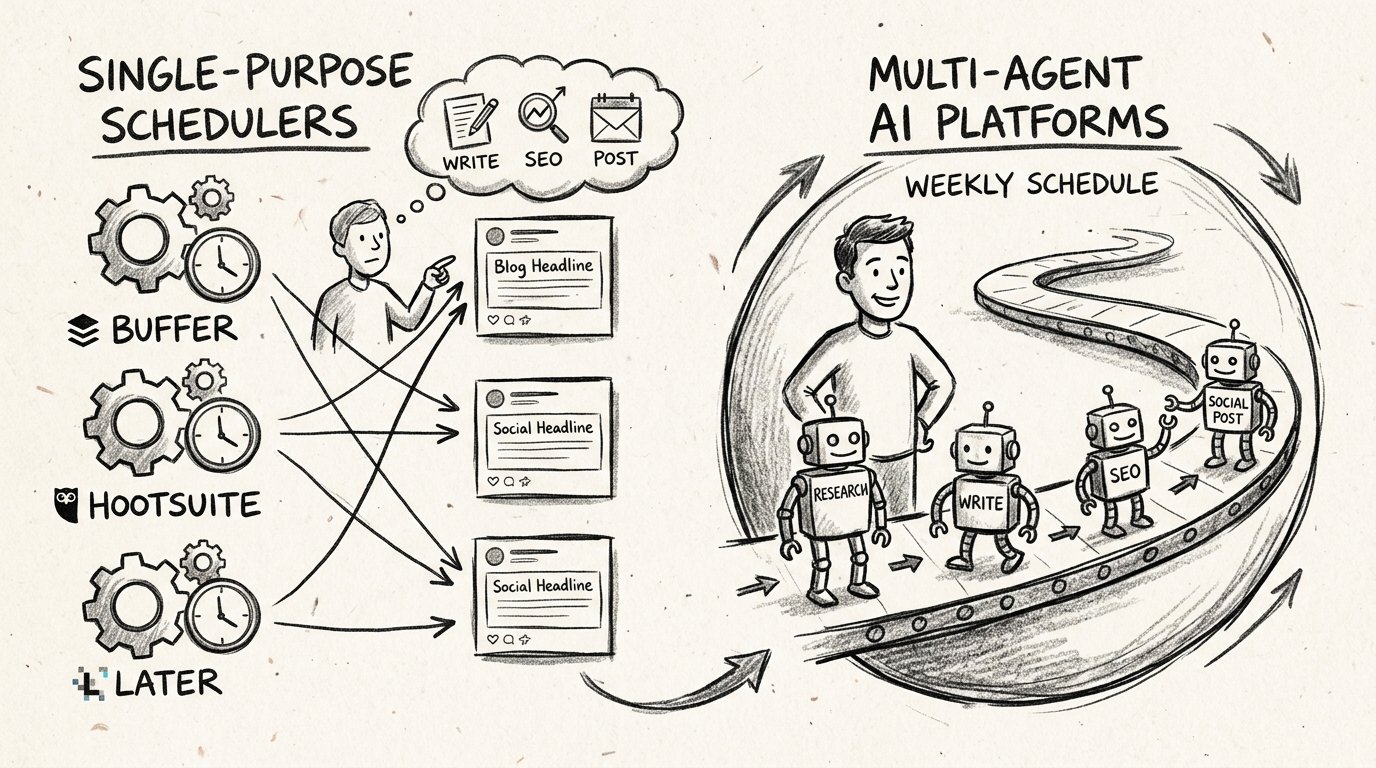
The tools that automate content writing, SEO, and social media posting on a weekly schedule fall into two distinct categories: single-purpose schedulers (Buffer, Hootsuite, Later) that handle one job well, and multi-agent AI platforms that run the entire pipeline — research, writing, SEO, and social — as a coordinated crew on a recurring cadence.
Understanding the difference matters because the right choice depends on whether you need a publishing calendar or a full content operation. If you already have writers and an SEO strategy, a scheduler fills the gap. If you need the research, drafting, optimization, and scheduling all handled automatically — with a human approving each output before it goes live — a single-purpose tool will leave most of the work on your desk.
Single-Purpose Scheduling Tools: What They Do and Where They Stop
Scheduling tools are mature, affordable, and good at their specific job: take content you’ve already created, queue it across platforms, and post it at optimal times.
Popular options include:
- Buffer — straightforward queue-based scheduling for LinkedIn, Instagram, Facebook, and X; strong for small teams that want simplicity
- Hootsuite — broader feature set with social listening, inbox management, and paid-social analytics; better suited to teams managing community interaction at scale
- Later — built around visual content planning, particularly strong for Instagram
- Post Planner — combines content curation with scheduling; covers Facebook, Instagram, LinkedIn, X, Pinterest, TikTok, YouTube, and Threads in a single dashboard
These tools are genuinely useful if you have content to feed them. The limitation is everything upstream: they do not research topics, write drafts, optimize for search, or tell you what to publish next week. That work still requires a person — or a separate set of tools stitched together manually.
The Fragmentation Cost
Stacking separate tools for SEO research, content writing, and social scheduling is the obvious approach for small teams, but it creates operational drag. Each tool has its own login, its own data model, and its own reporting format. Content drafted in one tool does not automatically inform the SEO brief in another. Social posts do not inherit voice or topic context from the articles they should be repurposing.
54% of small businesses now use AI marketing tools, with another 27% planning adoption within the next 12 months — making marketing the fastest AI entry point for small firms (U.S. Chamber of Commerce, August 2025). The challenge is not access to AI; it is whether you have a coherent system or a stack of disconnected tools that each require manual handoffs.
Multi-Agent AI Platforms: The Full-Pipeline Alternative
A multi-agent AI platform replaces the manual handoffs between tools with a coordinated crew of specialized agents — each with a defined role, running on a weekly schedule, and handing work to the next agent automatically.
How the Content and SEO Pipeline Works
The most important distinction from a scheduler is that the work starts with data you already have. A Scout agent pulls query and traffic data from Google Search Console, identifies topics with ranking potential, and produces a structured brief. A Writer agent takes that brief, researches supporting sources, verifies citations against the source pages before linking them, and produces a long-form draft. An Editor agent scores the draft against a brand rubric and flags it for revision if it falls short.
When the draft passes review, a Publisher agent pushes it to WordPress or Webflow as a draft — not a published post. Nothing publishes until you make an explicit decision. This is how an AI agent crew runs SEO, content, social, and ads under one subscription — the agents handle the recurring operational work while you retain final say on every output.
About 94% of marketers plan to use AI in their content creation processes in 2026 (HubSpot State of Marketing Report, 2026). The gap between teams planning AI adoption and teams running a coordinated pipeline is the difference between using AI as a writing assistant and deploying it as a repeatable system.
How Social Posting Fits Into the Pipeline
Once an article is approved, a Repurposer agent adapts it into channel-specific posts — a structured LinkedIn post, a shorter caption for Instagram, a thread format for X, a Facebook-friendly version — each matched to the native conventions of the platform rather than a one-size-fits-all copy-paste.
A Newsjacker agent separately monitors trending news and drafts timely posts from relevant stories. A Thread Scout agent surfaces engagement opportunities. A Social Scheduler queues everything to your approved calendar. Nothing reaches a live channel without your explicit approval; posts wait on the calendar until you click through.
This is different from a scheduler in a fundamental way: the social content is generated from your own approved articles and real-time news, not created manually and then uploaded. The pipeline feeds itself on a weekly cadence.
What “Human Approval” Actually Means in Practice
The human-in-the-loop requirement is not a limitation — it is the feature that makes this viable for brand-sensitive teams. mktcrew’s approach to AI marketing automation gives agents the role of researching, drafting, formatting, and queuing every output, while keeping every publish decision with a person.
In practice:
- Articles land in your CMS (WordPress or Webflow) as drafts; you publish when ready
- Social posts appear on your calendar awaiting approval; nothing auto-posts
- Paid media recommendations surface in weekly reports; no agent touches live campaign settings, bids, or budgets
- Run history shows when each agent executed and whether it succeeded — so you can see exactly what the crew did each week
Role-based access controls let owners, admins, and editors operate at different permission levels. OAuth-only integrations mean platform passwords are never stored.
Choosing the Right Tool for Your Situation
The decision comes down to what is already handled versus what still needs to happen.
- Use a scheduler (Buffer, Hootsuite, Later) if you have a content and SEO workflow producing drafts and just need reliable, multi-platform distribution.
- Use a multi-agent platform if you need the research, writing, SEO optimization, and scheduling all running on a weekly cadence without managing each step yourself.
For lean teams, startups, and founders running marketing without a dedicated department, a scheduler covers the last mile but leaves most of the work unsolved. A coordinated AI agent crew covers the entire operation — from topic research to CMS draft to queued social post — on a schedule, with approval at every step.
Conclusion
Single-purpose scheduling tools solve the distribution problem efficiently. Multi-agent AI platforms solve the production problem: researching what to write, writing it, optimizing it for search, and feeding the social calendar — all on a weekly schedule that runs whether or not anyone has time to manage it. The right choice is the one that matches where the bottleneck actually lives in your workflow.