August 23, 2026
How to Get AI-Powered Ad Recommendations Without Letting Software Touch Your Live Campaigns
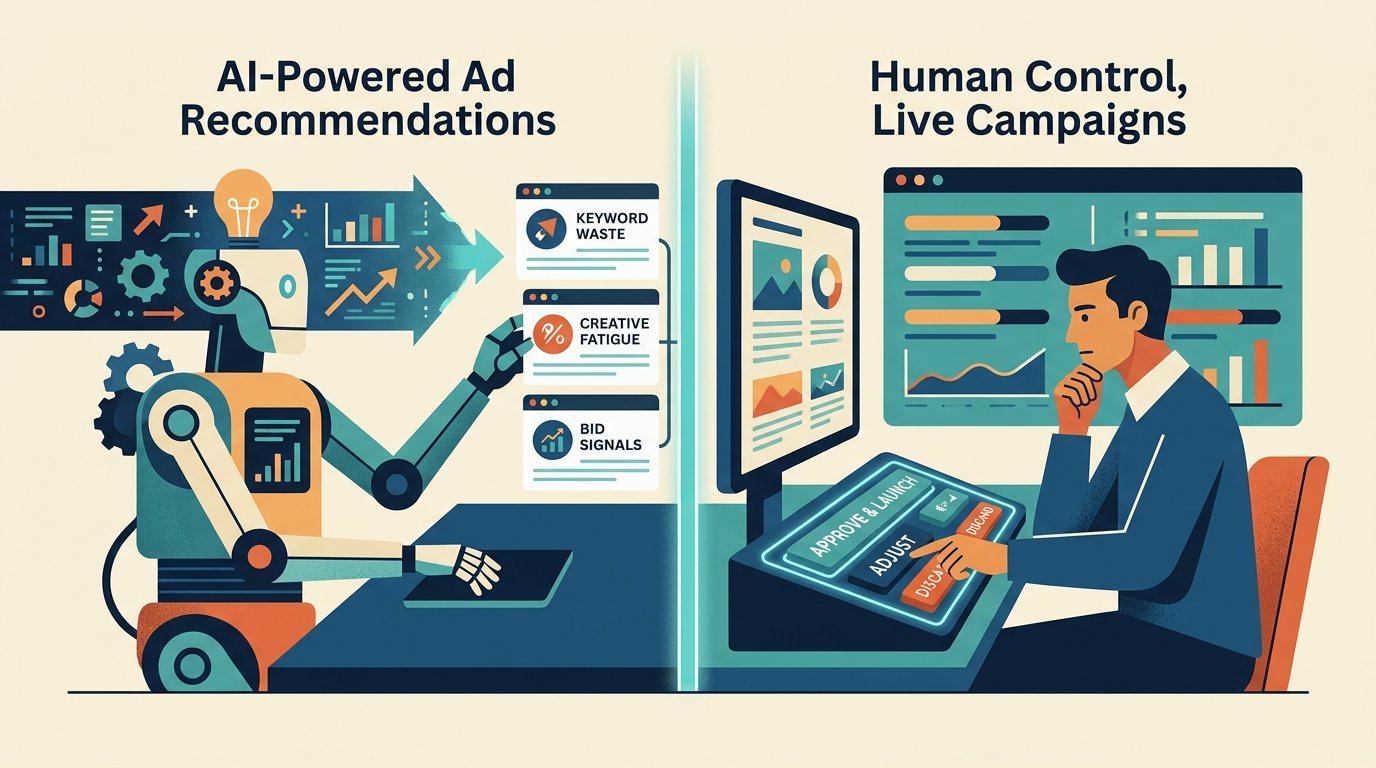
Recommendation-only AI gives you the analytical depth of a dedicated PPC manager — surfacing keyword waste, creative fatigue, and bid signals — while keeping every actual change behind a human decision. For a lean startup or solo founder, that separation is not a nice-to-have; it is the only model that makes autonomous AI in your ad accounts affordable to get wrong.
The Two Operating Models — and Why the Difference Matters
Every AI paid-media tool sits in one of two camps. Autonomous execution platforms connect directly to ad platform APIs and write changes to live campaigns: bid adjustments, budget reallocations, audience expansions, and paused ad sets happen without a human clicking approve. Recommendation platforms analyze the same signals but stop short of touching live accounts — every suggested change lands in a review queue for a person to accept or discard.
A useful third category exists — rule-based automation, where you define triggers (“if CPA exceeds $80, pause this ad set”) — but it still requires you to author the rules in advance and cannot reason across signals the way AI can.
For large teams with dedicated PPC managers watching dashboards daily, the execution camp can be powerful. For a founder running a $3,000/month Google Ads budget alongside eight other jobs, the risk calculus flips. Greenlane Marketing has documented the failure mode plainly: an autonomous Google Performance Max campaign can appear to be performing well — conversions look healthy, CPA looks acceptable — until someone asks about lead quality and discovers the algorithm has been optimizing toward spam submissions and job-seekers instead of qualified prospects. “If you train the algorithm on low-quality leads, it will find you more low-quality leads,” Greenlane’s Paid Media Director notes. By the time you catch it, the budget is gone.
That risk is compounded for a small team precisely because there is no one monitoring dashboards at 9 a.m. to catch drift before it compounds. Recommendation-only AI removes write-access from the equation entirely, so the worst outcome of a bad AI suggestion is a change you never made.
What Good Paid-Media AI Recommendations Actually Look Like
Recommendation-only does not mean low-value. The most useful AI ad insights map directly to the weekly decisions a founder or small marketing team has to make anyway — they just get surfaced faster and with more data behind them.
Search term and keyword signals
A Google Ads optimizer agent ingests your Search Console data and campaign reports, then flags search terms that are triggering spend without converting. On a manual workflow this analysis takes 30–60 minutes per account per week. Surfaced as a weekly recommendation, it becomes a five-minute approval decision: add these terms as negatives, or adjust match types.
Creative fatigue flags
Meta Ads performance degrades as audiences see the same creative repeatedly — frequency rises, CTR drops, and CPM climbs as the algorithm pushes harder to find new impressions. An AI agent tracking frequency-to-CTR ratios across your active ad sets can flag fatigue before spend accelerates, giving you a concrete prompt to refresh copy or swap creative.
Bid strategy and budget allocation signals
Bidding recommendations — whether to shift a campaign from manual CPC to Target CPA, or to move budget from an underperforming ad group to one showing stronger conversion velocity — are exactly the kind of analysis that takes experienced media buyers hours to compile manually but can be produced automatically from performance data. Improvado reports that AI applied to media buying workflows can reduce manual optimization work by up to 87%. The recommendation model captures most of that analytical benefit without the execution risk.
Audience overlap alerts
Running similar audiences across Google, Meta, and LinkedIn simultaneously is a common setup for B2B startups. AI can detect when audiences overlap significantly, causing you to compete against yourself at auction — a signal that rarely surfaces without deliberate cross-channel analysis.
Running a Weekly Cross-Channel Review With a Human-Approval Layer
The practical workflow for a solo founder or small team looks like this: AI agents sync daily with your Google Ads, Meta Ads, and LinkedIn Ads accounts via OAuth (no platform passwords stored), analyze performance against your historical benchmarks, and queue recommendations once per week. On your review day — 20–30 minutes — you work through the queue: accept a negative keyword list, dismiss a bid change you disagree with, flag a creative fatigue warning to your designer.
Nothing changes in your live campaigns until you click. The agents never touch bids, budgets, targeting, or copy in a live account. That is a meaningful structural constraint, not just a policy — the integration layer has read access to your data and write access only to the recommendation queue.
This is how mktcrew’s Google Ads, Meta Ads, and LinkedIn Ads optimizer agents are built: they sync daily, surface evidence-backed recommendations, and require explicit human approval before any change is considered. No autonomous execution. No live campaign mutations. The benefit is the analysis; the control stays with you. You can read more about how this fits into a broader lean-team paid media setup in managing Google and Meta Ads without a dedicated media buyer.
The cross-channel view matters as much as the individual-channel signals. Most AI tools cover Google Ads or Meta Ads in isolation. A combined weekly recommendation that spans Google, Meta, and LinkedIn — showing you where budget is performing, where creative is fatiguing, and where audiences are overlapping — is the analytical output that a PPC manager would otherwise spend half a day assembling.
The Right Question to Ask Any AI Paid-Media Tool
Before evaluating features or pricing, ask one question: does this tool recommend, or does it execute? If it executes, ask a follow-up: what are the guardrails, and what happens when the AI gets it wrong?
For lean teams, the answer to the second question is usually “there are no guardrails sufficient for our risk tolerance.” Autonomous execution platforms are designed for teams with dedicated oversight. Recommendation-only AI — properly built with a human-approval layer — gives founders and small marketing teams the analytical horsepower of a PPC specialist without handing over the keys to live spend.
The point is not that AI cannot be trusted with ad campaigns. It is that trust should be commensurate with your capacity to catch and correct errors. For most small teams, that capacity is limited — and the recommendation-only model is the honest acknowledgment of that reality.