August 7, 2026
How to Manage Google and Meta Ads Without a Media Buyer: A Lean Team Playbook
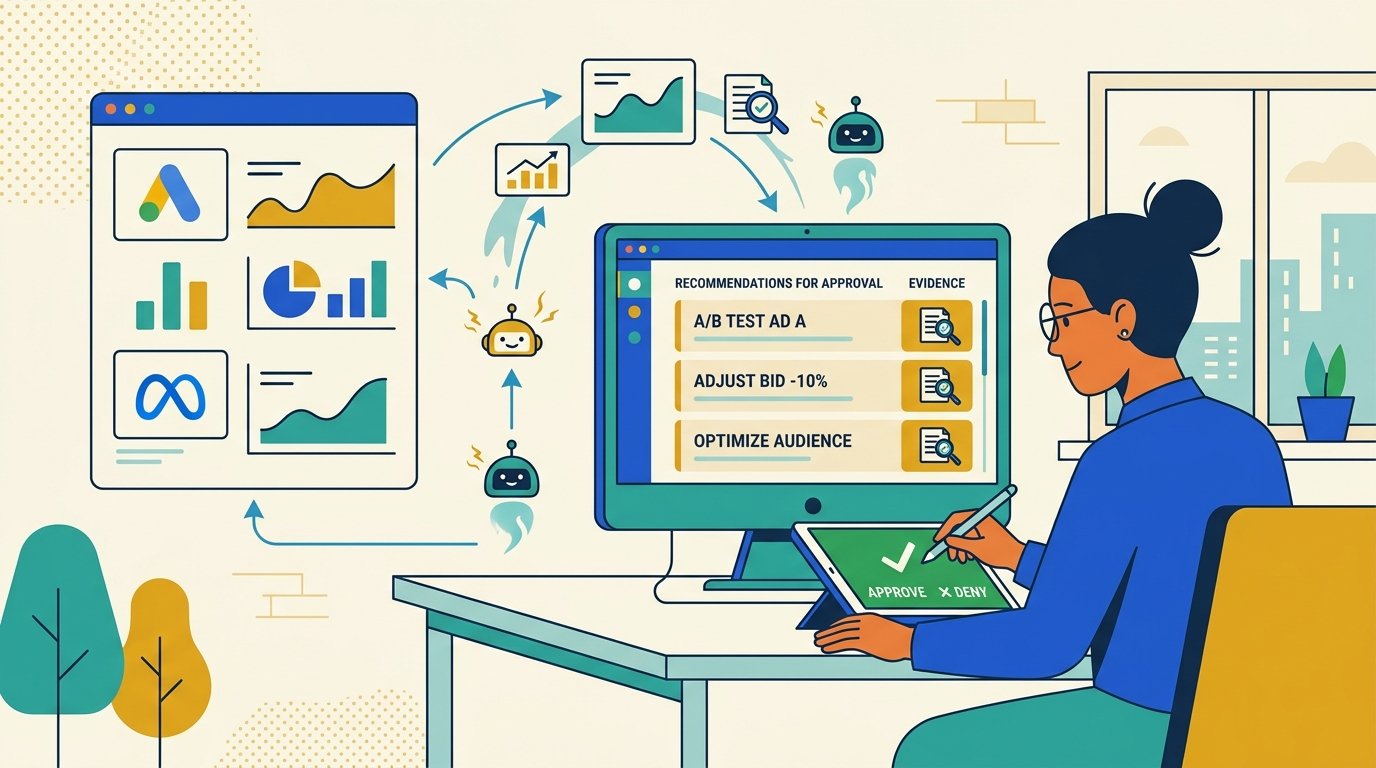
A lean team can manage Google, Meta, and LinkedIn Ads without a media buyer by pairing daily AI-synced optimization agents with a human approval layer — getting evidence-backed recommendations on what to change, while keeping every live decision in the operator’s hands.
That model flips the traditional paid-media equation. Right now, most founders and small marketing teams face a binary choice: hire an agency (and pay for it) or make ad changes manually (and risk making the wrong ones). Neither is a clean answer.
The Real Cost of an Agency Media Buyer
Agency fees for paid-media management are not small. For a local business spending $1,000–$5,000 per month on ads, typical management fees run $500–$2,000 per month on top of ad spend. Mid-market accounts spending $5,000–$25,000 per month see management fees of $1,500–$5,000 monthly — and many agencies layer on a percentage-of-spend model on top of that flat retainer, commonly 10–20% of monthly media budget (OuterBox, PPC Management Pricing 2026).
For a startup spending $8,000/month on Google and Meta ads combined, a 15% fee plus a base retainer can add $2,000–$3,000 in monthly overhead — before a single optimization is made. That is overhead a lean team or founder-led operation often cannot justify, especially when the agency’s decisions still happen inside a black box.
The alternative — going it alone — has its own risks. Without a clear read on which keywords are burning budget, which ad sets have fatigued audiences, or which bidding strategies are misfiring, manual management tends to produce either over-spending on what is familiar or under-investing in what is working. Neither outcome is deliberate.
Why “Auto-Apply” Recommendations Are the Wrong Fix
Google Ads and Meta both surface native optimization recommendations. Both platforms also offer auto-apply settings that can execute those recommendations without a human reviewing them first.
Turning auto-apply on hands bid adjustments, budget shifts, and audience expansions to an algorithm whose primary objective is platform revenue, not your ROAS (return on ad spend) target. The absence of human review is the problem, not the solution.
How AI Optimizer Agents Work Without Touching Live Campaigns
The human-in-the-loop model for paid media works differently from both agency retainers and auto-apply features. Here is the plain-language version of how it operates:
Connect once via OAuth. The ads platforms — Google Ads, Meta Ads, LinkedIn Ads — authorize read access through OAuth. No passwords are stored anywhere, and the connection is established once at setup.
Agents sync and analyze daily. Optimizer agents pull fresh campaign data every day: impressions, clicks, conversions, cost-per-acquisition, quality scores, audience overlap, and creative performance. They analyze patterns across that data and compare them against your account’s historical benchmarks.
Recommendations surface in your dashboard. Each recommendation is evidence-backed — tied to a specific data signal, not a generic platform suggestion. Examples include: pausing a keyword cluster with a high cost-per-click and zero conversions in 30 days; flagging an ad set where frequency has exceeded 4.0 and engagement rate has dropped; or surfacing a bid strategy switch that the account’s conversion volume now supports.
You decide what executes. Nothing in the live account changes without your explicit approval. The agent’s job is analysis and recommendation. The operator’s job is judgment and action. That division is the entire point.
mktcrew’s Google Ads Optimizer, Meta Ads Optimizer, and LinkedIn Ads Optimizer follow this pattern exactly — they sync daily, surface recommendations only, and never mutate live campaigns, bids, or budgets.
What a Weekly Paid-Media Review Looks Like Without an Agency
For a founder or single-person marketing team running this workflow, a weekly review takes roughly 30–45 minutes and covers five areas:
- Budget pacing: Are campaigns on track to hit monthly spend targets without overshooting?
- Conversion anomalies: Did any campaign’s CPA (cost per acquisition) spike or drop more than 20% week-over-week? What does the agent flag as a likely cause?
- Creative fatigue signals: Which ad sets are showing declining click-through rates or rising frequency scores that suggest audiences have seen the creative too many times?
- Keyword and audience quality: Are there new negative keyword candidates? Are any audience segments underperforming against the account average?
- Recommendation queue: What has the optimizer surfaced since the last review, and which items have clear enough evidence to approve and action?
This is the exact review checklist that separates deliberate paid-media management from either blind manual tinkering or handing the wheel entirely to an algorithm.
Running Multi-Channel Ads on One Subscription
One of the structural advantages of AI optimizer agents over a traditional agency retainer is coverage. A typical agency engagement covers one or at most two platforms. Adding LinkedIn Ads management on top of an existing Google Ads retainer usually means renegotiating scope or engaging a second vendor.
An AI-agent approach covers Google Ads, Meta Ads, and LinkedIn Ads simultaneously from a single subscription — each with its own daily sync cadence, its own recommendation logic calibrated to platform-specific metrics, and the same human-approval gate before anything changes.
For lean teams who need consistent multi-channel paid-media oversight without the cost or coordination overhead of separate agency relationships, that coverage model is materially different from what was previously available to teams of one or two people.
74% of marketers in 2025 said AI is either critically important or very important to their marketing success — an eight-point jump from 2024 (Capsule CRM). The traction is there. The question for a lean operator is whether the AI tools they choose actually enforce human approval or quietly bypass it.
The answer matters most in paid media, where an unauthorized bid change or budget shift can produce real financial consequences before anyone notices.
Bringing It Together
Managing Google and Meta Ads without a media buyer is not about removing expert judgment from the loop — it is about shifting where that judgment lives. AI optimizer agents handle the daily data-processing work that previously required a retained specialist. The founder or lean-team operator retains full decision authority over every change.
The AI marketing agents model extends the same principle across content, SEO, social, and reporting — giving a small team the operational coverage of a full marketing department, with human approval required before anything goes live. Paid media is one layer of that crew, not a standalone tool. When the optimizer agents, the reporting agent, and the content pipeline all run on the same weekly cadence and feed into the same dashboard, a single operator can stay in front of every channel without needing to hire for each one.