August 25, 2026
From Brief to Live to Optimized: How an AI Marketing Crew Runs a Full Campaign End to End
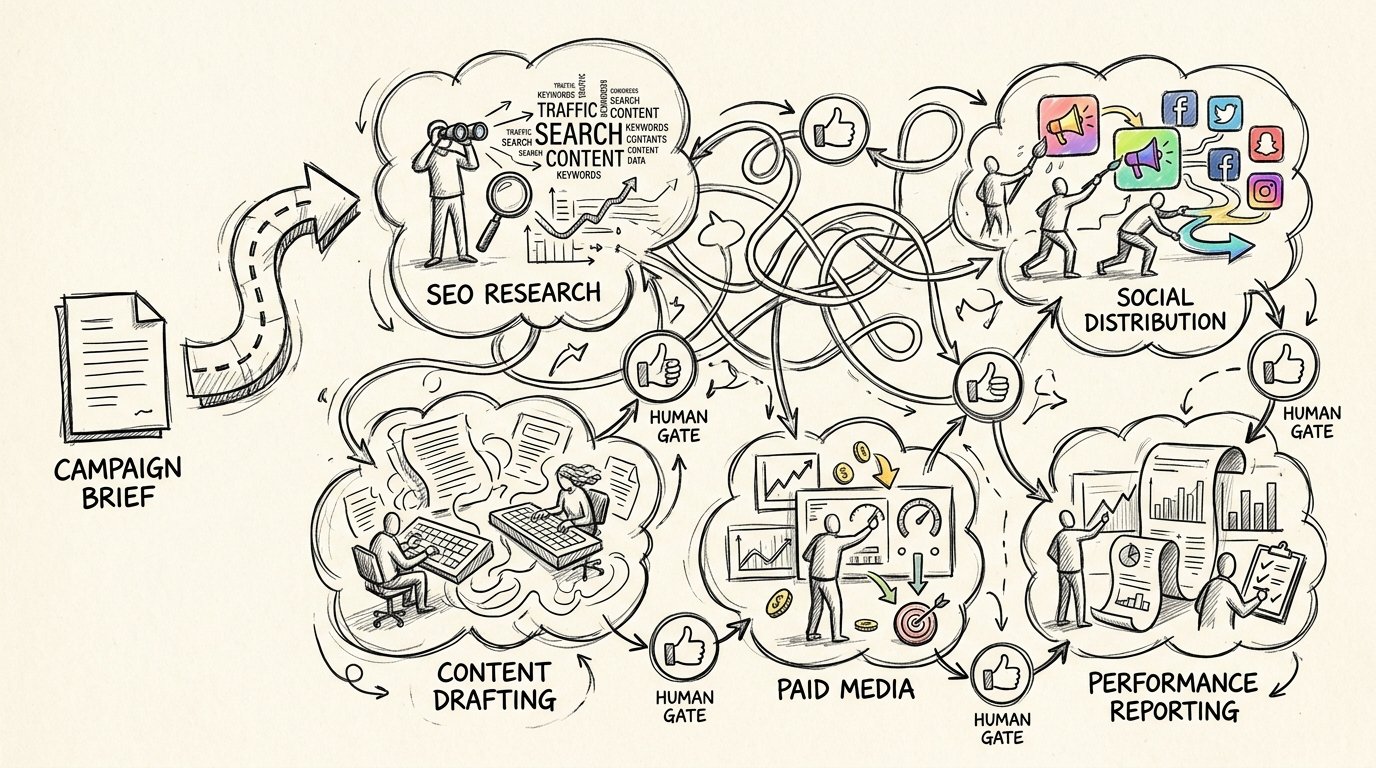
An AI marketing crew takes a single campaign brief and runs it through every channel — SEO research, content drafting, social distribution, paid media recommendations, and performance reporting — handing off between specialized agents automatically while human approval gates remain open at every step that matters.
Most coverage of AI marketing focuses on individual tools doing individual tasks. What’s missing is the full picture: what happens from the moment a brief lands to the moment post-launch data triggers the next round of refinements, and where humans stay in the loop throughout. This walkthrough covers the entire lifecycle using a concrete scenario.
Stage 1 — The Brief Lands and the Crew Orients
The scenario: you want to run a campaign around a new feature launch targeting small SaaS teams. You write one sentence describing the goal. That’s the brief.
From here, no human orchestration is required between agents. The SEO agent pulls your connected Search Console data, identifies the queries your audience is already using to find solutions like yours, and surfaces a cluster of target keywords with volume and competition signals. It doesn’t recommend based on generic industry data — it works from your actual search footprint.
Simultaneously, the competitor monitoring agent runs its weekly check. It flags any recent moves from tracked rivals: new landing pages, updated positioning, fresh content targeting the same keyword cluster. That intelligence feeds into the brief alongside the SEO output. Not five separate tools you open and configure separately — one crew reading the same brief.
The content agent (Scout) then drafts a topic brief: a specific angle, a recommended word count, the PAA questions being searched in your space, and source URLs to investigate. The brief is handed to the Writer agent, which produces a long-form article draft with verified inline citations. Each cited source is scraped and confirmed before the link is included — no hallucinated references.
The Editor agent scores the draft against your brand rubric — tone, claim accuracy, structural quality — before it ever reaches you. Weak drafts loop back for revision. Only drafts above your defined threshold reach your review queue.
Human checkpoint #1: You review the content batch. You approve, request edits, or skip. Nothing advances until you decide.
Stage 2 — Distribution Agents Prepare in Parallel
While the content draft is in your review queue, distribution agents are already preparing their outputs — they don’t wait for content approval to start their work.
The Repurposer agent reads the article draft and generates channel-specific social posts for LinkedIn, Facebook, Instagram, and X. Each post is adapted to the platform’s format and tone norms, not copy-pasted. The Social Scheduler queues them against your approved calendar cadence.
The Google Ads Optimizer, Meta Ads Optimizer, and LinkedIn Ads Optimizer agents sync daily with your connected ad accounts. For a new feature campaign, they surface evidence-backed recommendations: audience targeting adjustments, creative copy angles based on current performance data, and budget allocation signals. These surface as recommendations in your dashboard. McKinsey estimates that generative AI could improve marketing productivity by 5–15% of total marketing spend — the operational efficiency unlocked by agents preparing in parallel across channels is a direct example of that leverage.
Critically, no ad optimizer agent ever touches your live campaigns. Bids, budgets, and targeting settings remain exactly as you left them. The agents surface the recommendation; you decide whether to act on it in your ad platform.
Human checkpoint #2: You review the full distribution batch — social posts and ad recommendations — and approve, reject, or request changes post-by-post.
Stage 3 — Approval Triggers Execution
Once you approve, each piece moves to its next step automatically.
The Publisher agent pushes the approved article to your WordPress or Webflow CMS as a draft. It lands with formatting intact and the correct metadata applied. There’s a final CMS publishing step that remains in your hands — the Publisher never clicks “publish” on a live post.
Approved social posts move to your calendar. The Social Scheduler publishes them at the approved times. Approved ad recommendations are yours to implement — the agents don’t act on their own suggestions.
Human checkpoint #3: The article is in your CMS as a draft. You review it one final time in context, then publish. The campaign is live.
Stage 4 — The Signal Loop Closes
This is the stage competitor content never covers, and it’s where an AI crew separates itself from a collection of single-purpose tools.
Once the campaign is live, the reporting agents begin compiling performance data. The SEO Agent pulls query impressions, click-through rates, and ranking movement from Search Console. The Reporter compiles a cross-channel digest — sessions from GA4, engagement from social accounts, spend and conversion signals from connected ad platforms — into a weekly narrative report with an executive summary and structured metric cards.
That report isn’t just for your review. It feeds back upstream. If the article is ranking for queries adjacent to the original target cluster, the SEO agent notes the signal and surfaces a new brief — a follow-up article targeting the gap. If a social post format drove significantly higher engagement, the Repurposer’s next batch weights toward that format. If an ad recommendation from Stage 2 was implemented and improved ROAS, the optimizer agents factor that outcome into their next recommendation cycle.
The crew doesn’t reset between campaigns. Each cycle makes the next one more informed.
Human checkpoint #4: You review the weekly report, decide which follow-up briefs to greenlight, and the next cycle begins — again from a single decision.
What This Architecture Actually Means for a Lean Team
The practical difference between this model and building a stack of disconnected point tools isn’t just efficiency — it’s cognitive load.
With disconnected tools, a marketer is the orchestration layer. They carry context between the SEO tool and the content tool, between the content tool and the social scheduler, between the social scheduler and the ads platform. Every handoff requires a human to open something, copy something, and configure something. That overhead compounds weekly.
With a coordinated crew, the handoffs are structural. The SEO brief becomes the content brief. The content draft becomes the social posts. The social and ads agents prepare in parallel rather than in sequence. The performance data feeds back into the next SEO brief. A single subscription covers every channel; plans differ by monthly output volume, not by which agents you can access.
The human role shifts from orchestrator to approver and strategist — which is where human judgment actually creates value. As mktcrew’s human-in-the-loop model explains, the approval layer isn’t a constraint on speed; it’s what makes the crew trustworthy enough to hand recurring execution to.
Gartner’s 2025 survey (via Martech.org) found that 81% of marketing leaders plan to increase AI investment — but the organizations that will see returns are the ones that pair agent execution with structured human review, not the ones that chase full automation.
The Crew Handles the Cadence; You Set the Direction
A full-crew campaign lifecycle — brief, SEO research, content draft, editorial review, social prep, ad recommendations, live execution, performance reporting, signal feedback — runs every week on a schedule you define. You don’t manage the sequence. You approve the outputs and set the direction at each gate.
The 20 agents covering mktcrew’s content, SEO, social, paid media, and reporting functions don’t require you to configure a workflow for each campaign, manage a vendor relationship for each channel, or manually carry context from one tool to the next. The coordination overhead that occupies marketing operations roles in larger teams — and that falls to the founder or a solo marketer in lean ones — is absorbed by the crew’s architecture.
That’s what AI-powered marketing looks like in operation: not a list of features, but a continuous, self-coordinating workflow with human judgment at every consequential decision point.
Ready to see the crew run your first campaign? Start a 15-day free trial — no credit card required →