August 5, 2026
What Are the Top Alternatives to Hiring a Fractional CMO for Ongoing Marketing Execution?
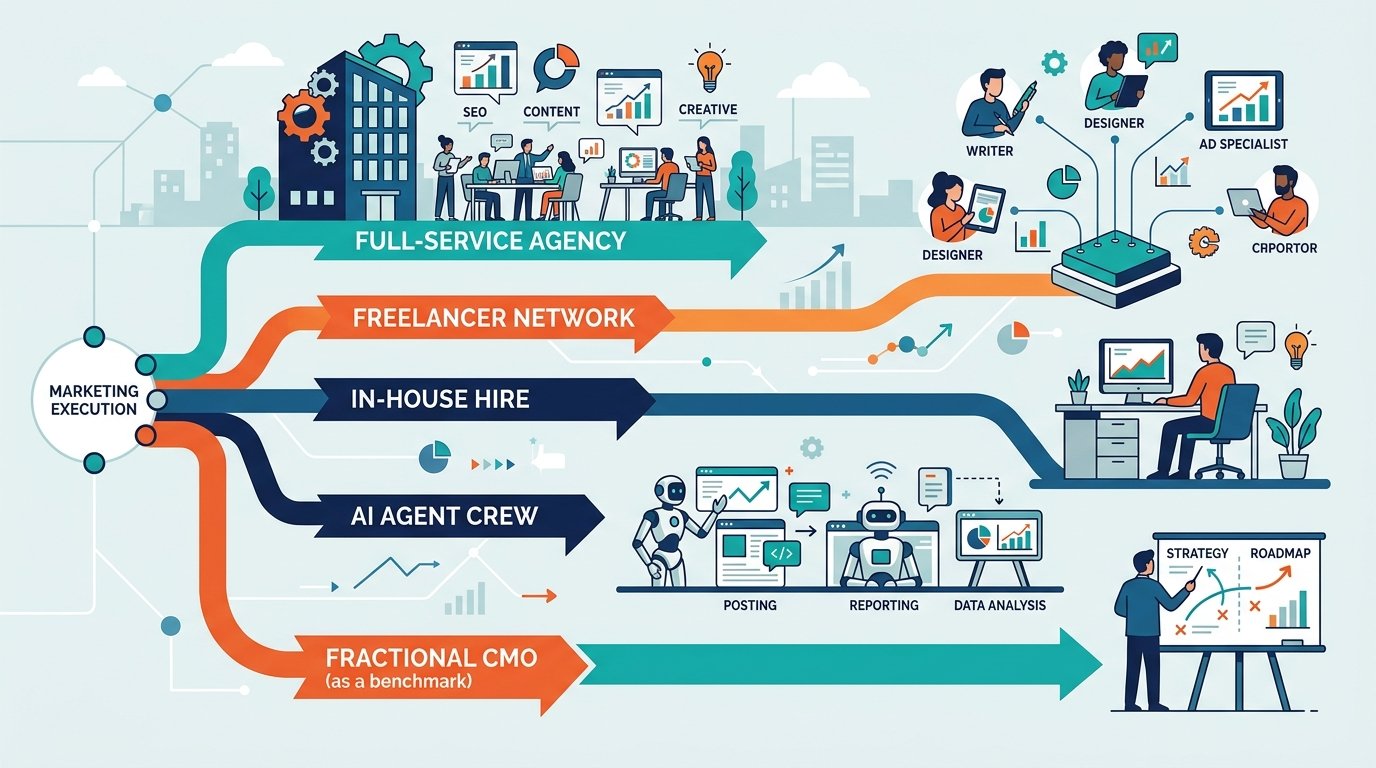
The top alternatives to a fractional CMO for ongoing marketing execution are: a full-service marketing agency, a network of specialized freelancers, an in-house marketing hire, and an AI agent crew — each with a different cost profile, speed-to-output, and human-oversight burden.
A fractional CMO earns its place when a company needs executive-level strategy — positioning, go-to-market decisions, board-level reporting. But strategy and execution are different problems. Most lean teams that explore fractional CMO options quickly discover their real bottleneck is not a lack of strategic vision; it is the weekly grind of producing articles, social posts, paid media reviews, and performance reports. That distinction drives which alternative is actually right for you.
Why the Strategy–Execution Gap Matters
A fractional CMO typically works 10–15 hours per week on strategy and oversight. Retainer rates in the US run $8,000–$22,000 per month, representing 60–70% savings over a full-time CMO base salary that averages roughly $190,000 — yet that budget still does not buy you content production, social publishing, or ad reporting. Those execution tasks need a separate layer.
The alternatives below fall into two groups: those that primarily address execution volume, and those that address both strategy and execution.
Four Alternatives and When Each Makes Sense
1. Full-Service or Specialized Marketing Agency
A marketing agency bundles execution capacity — SEO, content, paid media, social — under one retainer. According to MarkerHire’s 2025 analysis reported by Chariot Creative, a four-person in-house marketing team costs $450,000–$550,000 annually once salaries, benefits, recruiting, and tooling are factored in. A comprehensive agency partnership typically runs $50,000–$150,000 per year — a meaningful gap on paper.
The trade-offs are real, though:
- Account team turnover resets institutional knowledge of your brand.
- Deliverables are tied to campaign outputs (impressions, click-throughs) rather than your revenue outcomes.
- Monthly retainers often front-load setup time; execution velocity peaks after month two or three.
- Agencies rarely surface competitive intelligence or AI-search visibility data unless you pay for it separately.
Best fit: Companies that need brand-level creative work, paid media buying with human account management, or industry-specific PR alongside execution.
2. Network of Specialized Freelancers
Freelancers let you hire precisely the skill you need — a content writer for SEO articles, a media buyer for Google Ads, a social media manager for Instagram. Platforms like Contra, Toptal, and LinkedIn make sourcing faster than it was five years ago.
The coordination overhead is the cost. Managing three to five freelancers across channels requires a project owner inside your organization — often the founder or an overloaded marketing manager. Without a shared brand rubric and enforced quality standard, voice consistency degrades quickly. Freelancers also do not proactively flag what is missing; they execute the brief you give them.
Best fit: Teams that have a marketing coordinator to manage briefs and QA, and that need surge capacity for a defined project rather than a recurring weekly cadence.
3. An In-House Junior or Mid-Level Marketing Hire
Bringing a generalist marketer in-house gives you dedicated bandwidth and growing institutional knowledge. The average time to fill a marketing role is around 50 days (MarkerHire via Chariot Creative, 2025), and onboarding adds another four to eight weeks before meaningful output starts.
Modern marketing — SEO, paid media optimization, analytics attribution, AI-driven content — now demands specialist depth that a single generalist hire cannot fully cover. A content manager is not a paid media buyer. An SEO specialist is not a social strategist. Expecting one person to own all five recurring marketing jobs leads to the expertise gap that drove companies toward fractional models in the first place.
Best fit: Teams that have already resolved channel strategy and need a dedicated executor for one or two channels, not the full marketing surface area.
4. An AI Agent Crew for Ongoing Execution
The newest category is the AI marketing agent crew — a platform where specialized AI agents handle each discrete marketing job on a fixed weekly cadence, queue everything as a draft, and enforce human approval before any content reaches a live channel.
This model addresses the execution gap directly, without the coordination overhead of freelancers, the ramp time of an agency, or the hiring cost of an in-house team. It is not a replacement for strategy — it is the execution layer that runs underneath whatever strategy you or your fractional CMO sets.
What this looks like in practice, using mktcrew as an example:
- Content and SEO: A Scout agent researches topics from your Search Console data. A Writer agent produces long-form drafts with verified, linked citations. An Editor scores every draft against your brand rubric. A Publisher agent pushes approved articles to WordPress or Webflow as drafts — a final CMS publish step remains yours.
- Social: A Repurposer turns each approved article into channel-specific posts for LinkedIn, Facebook, Instagram, and X. Nothing goes to a live feed without explicit human approval.
- Paid media: Google Ads, Meta Ads, and LinkedIn Ads optimizer agents sync daily and surface evidence-backed recommendations — they never modify live campaigns, bids, or budgets.
- Competitive and AI-search intelligence: A Competitor Monitor tracks rivals weekly. An AI Visibility Monitor queries AI search engines monthly to flag whether your brand appears in AI-generated answers.
- Reporting: SEO and analytics agents compile weekly reports with executive summaries and metric cards drawn from GA4, Search Console, social accounts, and ad platforms.
All integrations use OAuth only — platform passwords are never stored. A brand profile covering positioning, voice, competitors, and a quality rubric is drafted from your site URL within minutes of sign-up, and steers every agent.
Best fit: Lean startups, small marketing teams, and founders running marketing themselves who need consistent multi-channel output every week without staffing a department or managing a roster of freelancers. Also a strong fit for teams already using a fractional CMO for strategy who need a reliable execution layer to act on that strategy.
How to Choose
The right answer depends on where your bottleneck actually sits:
- If you have no marketing strategy and no execution: start with a fractional CMO for strategy and an AI agent crew for execution simultaneously — the costs are additive but still far below a full in-house team.
- If you have a strategy but no execution: an AI agent crew or a specialized agency both work; the agent crew costs less and starts faster.
- If you have partial execution but gaps in specific channels: freelancers or a channel-specialist agency fill point gaps without displacing what already works.
- If you are growing toward a team of three or more: plan the in-house hire for the role that requires the deepest brand judgment, and keep recurring execution automated.
The common mistake is treating a fractional CMO as an execution resource. A fractional CMO at $10,000–$15,000 per month who is writing blog posts and scheduling social content is not using their hours well — and you are overpaying for that work by a wide margin.
Making the Transition
Whichever alternative you choose, the transition is smoother when you document your brand voice and positioning before handing execution to any external system, whether that is an agency, a freelancer, or an AI crew. A written brief that covers your target audience, core message, competitors to avoid, and channel preferences eliminates the most common source of misaligned output.
For teams evaluating the AI agent model, mktcrew’s 15-day free trial (no credit card required) starts by drafting that brand profile from your site URL, then delivers first article drafts to your CMS by Day 3 and a first SEO and analytics report by Day 7 — so you can assess real output before committing. For a broader comparison of platforms in this category, see What Are the Best AI Marketing Automation Platforms That Can Replace or Augment a Full Marketing Team?
The fractional CMO model solved the cost problem of full-time executive leadership. The execution problem — consistent, multi-channel output every week — is what these alternatives are built to solve.